
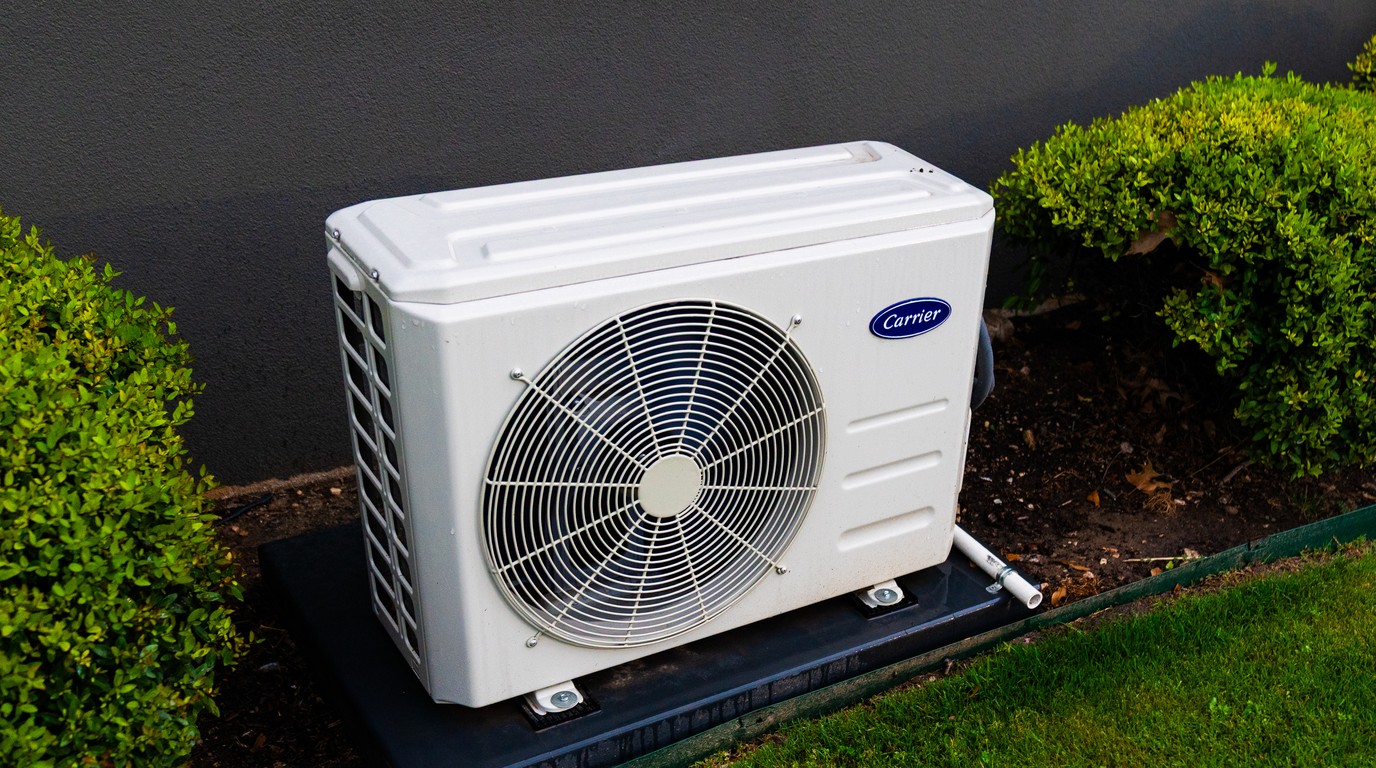
- Distribution Efficiency Penalty: Central ducted heat pump systems in residential retrofits lose 20% to 32% of total thermal energy through duct air leakage, conductive heat transfer in unconditioned attics/crawlspaces, and excessive external static pressure (ESP > 0.7 in. w.g.). Ductless mini-splits operate with 0% duct distribution loss.
- Inverter Turndown & Part-Load Modulation: Premium ductless mini-split indoor heads modulate down to 10% to 15% of rated capacity (e.g., 2,500 BTU/h minimum on a 18,000 BTU/h unit), preventing compressor cycling. Central ducted inverters frequently bottom out at 30% to 40% capacity, inducing short-cycling during mild heating loads (8°C to 14°C ambient).
- Seasonal COP Reality: On paper, top-tier central ducted and ductless systems both boast SEER2 ratings of 20+ and HSPF2 of 10+. However, in empirical field testing, multi-zone ductless installations deliver a real-world measured seasonal heating COP of 3.4 compared to 2.5 for central ducted setups due to zone elimination in unoccupied rooms.
Decarbonizing residential home heating requires choosing between two fundamentally divergent thermodynamic distribution architectures: central ducted cold-climate heat pumps vs. multi-zone ductless mini-splits. While central ducted systems appeal to homeowners seeking invisible HVAC hardware that preserves existing floor registers, engineering audits consistently reveal that the sheet metal ductwork hidden in walls and attics is the single largest bottleneck to energy efficiency.
In 2026, advances in vapor-injection rotary compressors, electronic expansion valves (EEVs), and low-ambient flash-injection circuits have largely eliminated the sub-zero capacity disparity between ducted and ductless equipment. Both architectures can sustain comfort at -25°C. However, the thermodynamic battle is won or lost in fluid dynamics: static pressure resistance, thermal duct conduction, and zoning turndown ratios.
How Much Energy Do Central Ducted Heat Pumps Lose to Static Pressure and Duct Leakage?
Central ducted heat pump retrofits lose an average of 20% to 30% of their delivered thermal capacity to duct leakage and thermal conduction through unconditioned attics. Furthermore, undersized legacy ductwork creates high static pressure (>0.8 in. w.g.), which forces the ECM blower motor into high wattage saturation, dragging overall system COP down by 15% to 25%.
In central ducted HVAC installations, the indoor air handler must force 350 to 450 cubic feet per minute (CFM) of air per ton of heating capacity through hundreds of feet of supply and return ducting. In existing North American homes built prior to 2015, duct systems were originally sized for fossil fuel furnaces operating with high supply air temperatures (55°C to 65°C). Because heat pumps deliver lower, continuous supply temperatures (38°C to 44°C), they require 20% to 30% higher volumetric airflow rates to satisfy the home’s Manual J thermal heat loss calculation.
Forcing higher CFM through undersized legacy ductwork spikes external static pressure (ESP) from the equipment design rating of 0.5 in. w.g. (inches water gauge) up to 0.8 or 1.1 in. w.g. The electronically commutated motor (ECM) blower ramps up to maximum RPM to overcome this aerodynamic drag, consuming 400 to 650 Watts of continuous parasitic electrical power instead of its 120-Watt baseline. Simultaneously, air leaks at sheet metal joints, boot connections, and unsealed return plenums vent conditioned air directly into unconditioned attics or pull in freezing crawlspace air. Ductless mini-splits bypass this aerodynamic penalty entirely: refrigerant lines deliver liquid and gas phase R-410A or R-32 directly to the conditioned living room, bedroom, or home office with zero distribution leakage.
| Engineering Parameter | Multi-Zone Ductless Mini-Split | Central Ducted Inverter Heat Pump | Thermodynamic Delta & Impact |
|---|---|---|---|
| Distribution Energy Loss | 0% (Direct refrigerant distribution) | 20% – 32% (Duct leakage & conduction) | Ductless saves 1,200 – 2,400 kWh/yr |
| Minimum Inverter Turndown | 10% – 15% rated capacity (2.5k BTU) | 30% – 45% rated capacity (12k – 16k BTU) | Ductless eliminates mild-weather short cycling |
| Zone Temperature Control | Independent per room (Micro-climate) | Single thermostat or motorized dampers | Ductless avoids conditioning empty guest rooms |
| Sub-Zero COP @ -15°C | 2.1 – 2.4 (Hyper-Heat single/multi) | 1.8 – 2.1 (Net of blower motor drag) | Ductless retains 15% superior net heating efficiency |
| Architectural Aesthetics | Wall heads, floor consoles, or ceiling cassettes | Completely concealed (Floor/ceiling grilles) | Central ducted wins interior design aesthetic |
The Multi-Head Trap: Why 1-to-1 Mini-Splits Outperform 4-in-1 Multi-Split Systems
Connecting four or five indoor mini-split heads to a single outdoor multi-split compressor creates an efficiency trap. Multi-split compressors have a higher minimum turndown floor (often ~12,000 BTU/h); when only one bedroom calls for 3,000 BTU/h of heat, the excess refrigerant bypasses into idle heads, causing over-heating and compressor short-cycling.
When HVAC contractors propose mini-split installations, they almost universally recommend connecting three, four, or five indoor evaporators to a single large 36,000 or 48,000 BTU/h multi-zone outdoor condenser to minimize exterior wall penetrations. From an engineering standpoint, this architecture introduces the “multi-head minimum modulation trap.”
A 36,000 BTU/h multi-split outdoor unit can typically modulate down to 30% of its rated compressor speed (~11,000 BTU/h minimum). On a mild 10°C evening, if only the primary bedroom is occupied and requesting 3,000 BTU/h of gentle heating, the outdoor compressor cannot slow down enough to match that single micro-load. Because refrigeration circuits cannot dead-end completely without freezing, the electronic expansion valves (EEVs) must allow a bleed flow of hot refrigerant through the idle indoor heads in the living room and kitchen. The system short-cycles, indoor heads click as coils expand, and seasonal efficiency collapses.
The gold-standard architectural solution is deploying 1-to-1 single-zone mini-splits for primary zones, or a hybrid architecture: a central ducted heat pump for common living areas paired with two dedicated single-zone mini-splits for bedrooms with heavy solar exposure or poor existing duct runs. Reviewing the COP Breakeven Formula for Heat Pumps vs. Natural Gas demonstrates how matching the right compressor modulation curve ensures operating costs beat cheap fossil gas even below freezing.
If your home has poorly insulated, leaky ductwork in an unconditioned attic or crawlspace with measured static pressure exceeding 0.7 in. w.g., installing a central ducted heat pump is throwing capital into a thermodynamic drain. Ductless mini-splits—specifically single-zone 1-to-1 pairings or compact ceiling cassettes—deliver 25% to 35% lower annual heating electricity consumption, eliminate duct heat conduction, and provide true room-by-room zoning comfort. Only choose central ducted if your existing ductwork has been audited with a duct-blaster, static pressure tested under 0.5 in. w.g., and interior aesthetics strictly prohibit wall-mounted indoor units.