
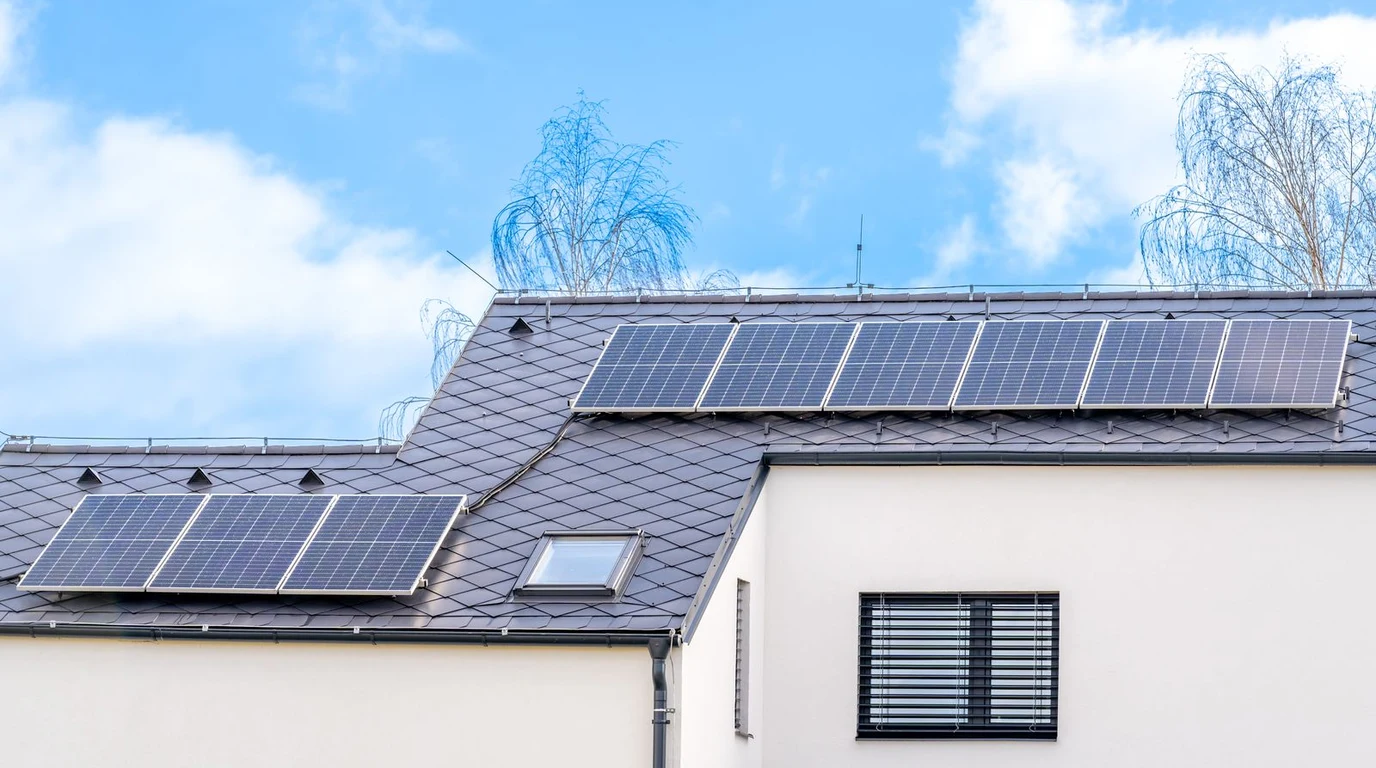
In utility-scale solar farms and commercial ground-mount arrays, bifacial solar photovoltaic modules have become the dominant global standard. By replacing traditional opaque polymer backsheets with dual-glass laminates and specialized transparent EVA encapsulation, bifacial panels capture sunlight striking both the front photovoltaic face and diffuse reflected irradiance bouncing off the ground onto the rear surface, boosting lifetime energy yields by 10% to 25%.
Driven by aggressive manufacturer marketing and falling module costs, residential solar installation companies are increasingly pitching bifacial solar panels for standard rooftop installations, promising homeowners a “free 15% energy bonus.” However, applying utility-scale ground-mount physics to typical residential rooftop architecture reveals a major engineering disconnect: rear-side solar gains depend entirely on ground albedo (reflectivity) and rear-side clearance height, both of which are severely restricted on standard asphalt shingle residential roofs.
Can Bifacial Solar Panels Work on a Residential Roof?
The mathematical physics governing bifacial photovoltaic generation is dictated by the Bifaciality Factor (typically 70% to 80% on modern monocrystalline PERC and TOPCon n-type cells) multiplied by the Surface Albedo Coefficient and the View Factor (the proportion of reflected radiation reaching the rear cells unobstructed by mounting hardware).
Roof Surface Albedo & Racking Elevation: The Physics Matrix
To understand why bifacial modules behave radically differently across roof types, solar engineers analyze how surface materials reflect light and how mounting heights influence diffuse irradiance:
| Roof Surface & Installation Architecture | Surface Albedo Coefficient | Racking Clearance (Height Above Deck) | Real-World Rear Bifacial Energy Gain |
|---|---|---|---|
| Standard Dark Asphalt Shingles (Flush-Mount) | 0.08 to 0.12 (absorbs 90% of light as heat) | 3 to 5 inches (standard L-foot mounting) | 1.5% to 3.5% (negligible economic return) |
| Light Gray / White Standing Seam Metal | 0.35 to 0.45 (reflective painted fluoropolymer) | 6 to 10 inches (elevated S-5! clamp racking) | 6.0% to 9.5% (meaningful kWh increase) |
| Commercial White TPO / EPDM Flat Roof | 0.60 to 0.75 (highly reflective cool roof membrane) | 12 to 18 inches (tilt-leg ballasted racking) | 12.0% to 16.5% (outstanding financial ROI) |
| Winter Fresh Snow Cover (Elevated Array) | 0.80 to 0.90 (near-perfect natural solar reflector) | 10 to 18 inches (clear of underlying snowpack) | 15.0% to 22.0% (melts snow while generating power) |
The Rear-Side Shading Trap: Racking Rail Interference
Even if you install bifacial modules over a white membrane or reflective roof, the physical geometry of residential racking systems often sabotages rear-side generation. Standard residential racking—such as IronRidge, Unirac, or SnapNrack—employs horizontal aluminum rails running directly beneath the cell strings.
Because photovoltaic solar cells operate in series strings, shading across a single cell bottleneck limits current for the entire string. When an aluminum mounting rail, optimizer mounting bracket, or microinverter casts a hard shadow across the rear cell lines, the bypass diodes in the junction box are triggered. This localized shading can cause cell mismatch losses, increase hotspot heating, and eliminate up to 60% of the theoretical bifacial gain.
To capture real bifacial production, installers must utilize bifacial-optimized racking architectures: rails that clamp strictly to the module perimeter frame without crossing the active cell area, paired with microinverters mounted clear of the rear glass.
Dual-Glass Durability: The Hidden Benefit of Bifacial Modules
While rear-side kilowatt-hour gains on dark asphalt roofs are modest, bifacial solar modules offer a secondary, highly significant advantage that has nothing to do with rear energy: dual-glass structural longevity.
Traditional monofacial solar panels use a glass front sheet bonded to a polymer plastic backsheet (Tedlar/PET). Over 15 to 25 years of harsh rooftop weather, thermal cycling, UV radiation, and moisture ingress cause polymer backsheets to yellow, become brittle, and develop micro-cracks, leading to PID (Potential Induced Degradation) and inverter ground fault errors. Dual-glass bifacial panels encase the solar cells between two sheets of heat-strengthened glass. Glass is completely impervious to moisture, zero-VOC, and physically immune to polymer degradation, resulting in slower annual cell degradation rates (<0.4% annually vs >0.7% in backsheet modules) and superior fire-safety ratings.
Winter Snow Shedding & Thermal Albedo Dynamics
In snowy northern latitudes, bifacial solar panels display a remarkable thermodynamic behavior: accelerated snow clearing. On monofacial solar arrays, snow accumulates on the glass and blocks 100% of generation until ambient temperatures rise or sun exposure slowly melts the crust.
On an elevated bifacial array, ground snow provides an immense albedo boost (reflecting up to 85% of ambient light). Even when several inches of snow completely cover the front glass face, diffuse reflected sunlight strikes the rear cells from beneath. This rear irradiance generates electrical current, causing the internal silicon cells to warm by 2°C to 5°C above ambient temperature. This gentle internal heat breaks the snowpack’s boundary adhesion, allowing heavy snow sheets to slide off the front face hours or days before monofacial panels clear.
Rapid Shutdown (RSD) & NEC 690.12 Code Compliance
When engineering rooftop bifacial arrays, installers must comply with NEC 690.12 Rapid Shutdown regulations, which mandate reducing array voltage to <30 Volts within 30 seconds of an emergency shutdown. Deploying module-level power electronics (MLPE)—such as SolarEdge optimizers or Enphase microinverters—is required by code.
However, mounting microinverters directly behind bifacial cells creates severe localized shading. Installers must specify rail-mounted offset brackets that suspend MLPE hardware below the racking plane, completely clear of the rear glass active cell zones, preventing bypass diode burnout and maximizing rear harvest.
Mechanical Wind Load & Hail Impact Resistance
Beyond electrical generation, dual-glass bifacial modules offer superior mechanical structural resilience. Standard monofacial panels with aluminum frames and polymer backsheets flex under heavy snow and wind loads, causing microscopic micro-cracks in fragile silicon wafers that lead to inactive cell fragments. Dual-glass bifacial laminates provide immense torsional rigidity, withstanding front static mechanical design loads exceeding 5,400 Pascals (approx. 112 lbs/sq ft), providing superior hail impact resistance against extreme weather events.
Do not pay a steep installer premium for bifacial solar panels expecting a 15% energy boost on a flush-mounted dark shingle roof—the laws of albedo and view factors make that physically impossible. However, if the price premium over monofacial panels is less than 5%, buy the bifacial panels anyway. The dual-glass construction eliminates polymer backsheet degradation, provides superior Class A fire resistance, and harvests valuable winter snow reflections when front panels are partially obscured.
Battery dispatch strategies achieve maximum capital return when paired with high-albedo solar generation. Dive into our forensic study on TOU Battery Arbitrage: Ultra-Low Overnight Rate Profit.