
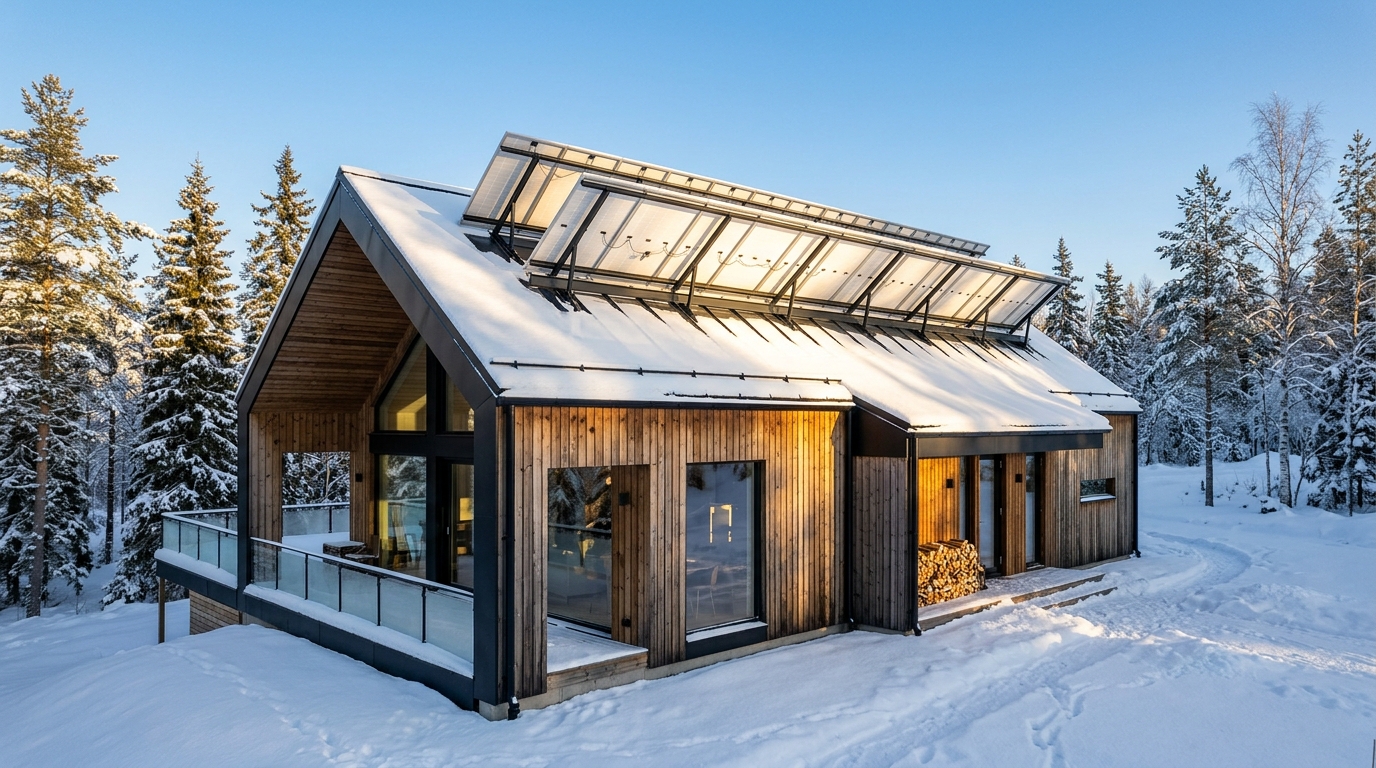
For residential solar system designers operating in northern latitudes—across Canada, the northern United States, Scandinavia, and high-altitude alpine regions—winter generation has historically been treated as a catastrophic write-off. Heavy snow coverage, low solar elevation angles, and short daylight hours routinely collapse monthly photovoltaic (PV) generation to less than 15% of summer peaks. In standard monofacial panel arrays with opaque backsheets, a 2-inch layer of snow renders the entire array completely inert for weeks at a time.
In 2026, advancing n-type TOPCon (Tunnel Oxide Passivated Contact) and heterojunction (HJT) cell architectures have made dual-glass bifacial solar panels the new standard for cold-climate residential installations. Rather than treating winter snow as a fatal obstruction, bifacial systems turn snow-covered ground into an active optical reflector. By capturing diffuse and reflected albedo radiation on their rear glass surfaces, bifacial arrays generate significant electrical current even when front surfaces are obscured, producing internal resistive heat that accelerates natural snow shedding.
- Albedo Reflection Multiplier: While standard asphalt shingles or dark soil reflect only 8% to 15% of ambient sunlight (albedo 0.08–0.15), fresh, uncompacted snow reflects between 80% and 90% (albedo 0.80–0.90) of incident irradiance, dramatically supercharging rear-side cell stimulation.
- Verified Bifacial Energy Yield: Field telemetry from northern testing stations demonstrates a 18% to 32% net annual energy yield increase for ground-mounted or elevated rack-mounted bifacial arrays compared to identical monofacial arrays in regions with >90 days of continuous snow cover.
- Thermal Snow Shedding Dynamics: Rear-side generation of just 20W to 40W per module initiates localized cell warming (Joule heating), creating a microscopic melt layer between the front glass surface and the snowpack that causes heavy snow slabs to slide off cleanly.
- Inverter DC/AC Sizing & Clipping: When high front-side irradiance combines with 85% snow albedo under clear sub-zero skies (elevating silicon operating voltage via negative temperature coefficients), peak DC power can exceed STC ratings by 125% to 135%, requiring careful microinverter pairing to prevent thermal clipping.
The Physics of Snow Albedo & Rear-Side Irradiance
The operational effectiveness of a bifacial photovoltaic module is governed by its bifaciality factor ($\phi$), defined as the ratio of rear-side nominal power output to front-side power output under Standard Test Conditions (STC):
While legacy p-type PERC bifacial modules achieved bifaciality factors of only 65% to 70%, modern 2026 n-type TOPCon modules achieve 80% to 85%, and n-type HJT modules consistently exceed 88% to 92%. In snowy environments, this high rear sensitivity transforms array performance:
- Total Effective Irradiance ($G_E$): The total irradiance absorbed by the module combines direct front irradiance ($G_F$) and ground-reflected rear irradiance ($G_R$):
G_E = G_F + (\phi imes G_R). - Ground Albedo Dynamics ($R_A$): Ground irradiance is directly proportional to surface reflectance. On a bright February day with 800 W/m² ambient horizontal irradiance over fresh snow ($R_A = 0.85$), the rear surface can receive over 250 W/m² to 350 W/m² of diffuse reflected light, depending on elevation height above the snowline.
- The Sub-Zero Voltage Bonus: Monocrystalline silicon possesses a negative temperature coefficient of power (typically -0.29% to -0.34%/°C). At -20°C ambient temperatures, solar cell efficiency increases by 12% to 15% above nominal 25°C laboratory ratings, compounding the albedo boost into immense instantaneous power peaks.
Bifacial Performance Matrix: Surface Types, Racking & Yield
The following performance matrix compares real-world albedo coefficients, rear-side generation multipliers, and annual yield deltas across diverse residential mounting configurations in sub-zero winter regions:
| Mounting Architecture | Ground / Roof Surface | Measured Albedo (Winter) | Snow Shedding Speed | Net Winter Yield vs Monofacial |
|---|---|---|---|---|
| Ground Mount (Tilt 45°, Height 1.2m) | Fresh Snowpack (>12 inches) | 0.82 – 0.88 | Immediate (<24 hours post-storm) | +28% to +35% Boost |
| Elevated Flat Roof (Tilt 35°, White TPO) | White Commercial Membrane + Snow | 0.75 – 0.84 | Fast (1–2 days) | +22% to +27% Boost |
| Pitched Roof (Flush Mount, 30° Tilt) | Dark Asphalt Shingles | 0.10 – 0.15 (Trapped cavity) | Slow (4–7 days snow damming) | +3% to +6% (Negligible gain) |
| Vertical Fence / Agrivoltaic (90° Tilt) | Surrounding Open Snowfield | 0.85 – 0.90 | Zero Accumulation (Slides off) | +40% to +50% Winter Spike |
Tilt Angle Optimization & The Flush-Mount Rooftop Trap
The single greatest operational error made by residential solar installers attempting to deploy bifacial technology is mounting bifacial panels flush against a dark asphalt shingle roof. On a standard pitched residential roof with 4-inch standoffs:
- Cavity Shadowing & Air Gap Suffocation: The clearance between the rear glass and the dark asphalt roof is insufficient for ambient light penetration. Rear cells receive less than 5% diffuse scatter, rendering bifacial gain non-existent.
- Snow Damming at Lower Array Margins: In low-clearance flush mounts, snow sliding down the roof dams against lower rail brackets, freezing into hard ice blocks that back up over bottom cell strings, triggering bypass diode activation and long-term hot-spot cell degradation.
To capture meaningful bifacial albedo gains in winter climates, systems must feature either:
- Ground-Mounted Arrays Elevated Above Maximum Snowpack: The lowest edge of the module rack must sit at least 1.0 to 1.2 meters (36 to 48 inches) above ground level. This prevents drifted snow from burying the lower frame and maximizes rear optical ground exposure.
- Elevated Commercial Flat-Roof Standoffs: Utilizing ballast racking tilted at 35° to 45° installed over high-albedo white TPO or PVC reflective roof membranes, providing at least 18 inches of rear ground clearance.
Inverter Sizing & The Microinverter Clipping Paradox
Bifacial solar arrays in snowy climates create an unexpected challenge for inverter engineering: extreme instantaneous peak power. On a clear February afternoon with -15°C ambient air temperatures, 900 W/m² front irradiance, and 85% ground snow reflection, a 440W bifacial panel can produce upwards of 540W to 570W of instantaneous DC power.
If paired with standard microinverters designed with conservative 1.20 DC/AC oversizing ratios (such as an Enphase IQ8+ with a continuous AC output limit of 290W or IQ8M with 325W), the inverter will experience severe thermal clipping, discarding hundreds of watt-hours of free cold-weather energy. In winter bifacial arrays, system architects must select higher-capacity inverters—such as the Enphase IQ8X or high-current DC string inverters with wide MPPT voltage envelopes—to capture the full albedo dividend.
Bifacial solar technology is the ultimate antidote to the winter solar doldrums, but only when paired with sound physical architecture. Installing bifacial panels flush against a dark asphalt pitched roof is an absolute waste of capital—you pay for dual-glass silicon without capturing rear-side albedo. However, for ground-mounted arrays, high-tilt pergolas, and elevated white-roof installations, snow is not an impediment; it is a massive, free optical mirror. By elevating racks above the snowline and sizing inverters to handle cold-weather voltage spikes, northern homeowners can transform their winter solar production from an annual write-off into a high-yield energy asset.
People Also Ask
Do bifacial solar panels work better in the snow?
Yes. Because snow has an exceptionally high albedo reflectance (reflecting 80% to 90% of sunlight), bifacial panels capture significant light on their rear glass surfaces. This rear generation produces internal heat that melts the snow layer on the front glass, helping snow slide off days faster than on traditional monofacial panels.
Are bifacial solar panels worth it on a standard residential roof?
Generally no, if installed flush against dark asphalt shingles. Flush roof mounts leave only 3 to 5 inches of clearance, trapping shadows and restricting light from reaching the back of the panel. Bifacial panels are only worth the investment on ground mounts, carports, pergolas, or flat roofs with reflective white membranes.
What is the best tilt angle for solar panels in snowy climates?
For snowy northern climates, a tilt angle between 40° and 50° is optimal. Steeper angles allow snow to shed rapidly via gravity, align perpendicular to lower winter sun trajectories, and capture intense ground-reflected snow albedo on bifacial rear cells.
Do solar panels produce power when covered in snow?
Standard monofacial panels covered in thick snow produce 0% power because sunlight cannot reach the front silicon cells. However, elevated bifacial panels continue to generate 20% to 35% of their rated output from rear-side snow reflection, warming the cells and clearing the front snowpack.