
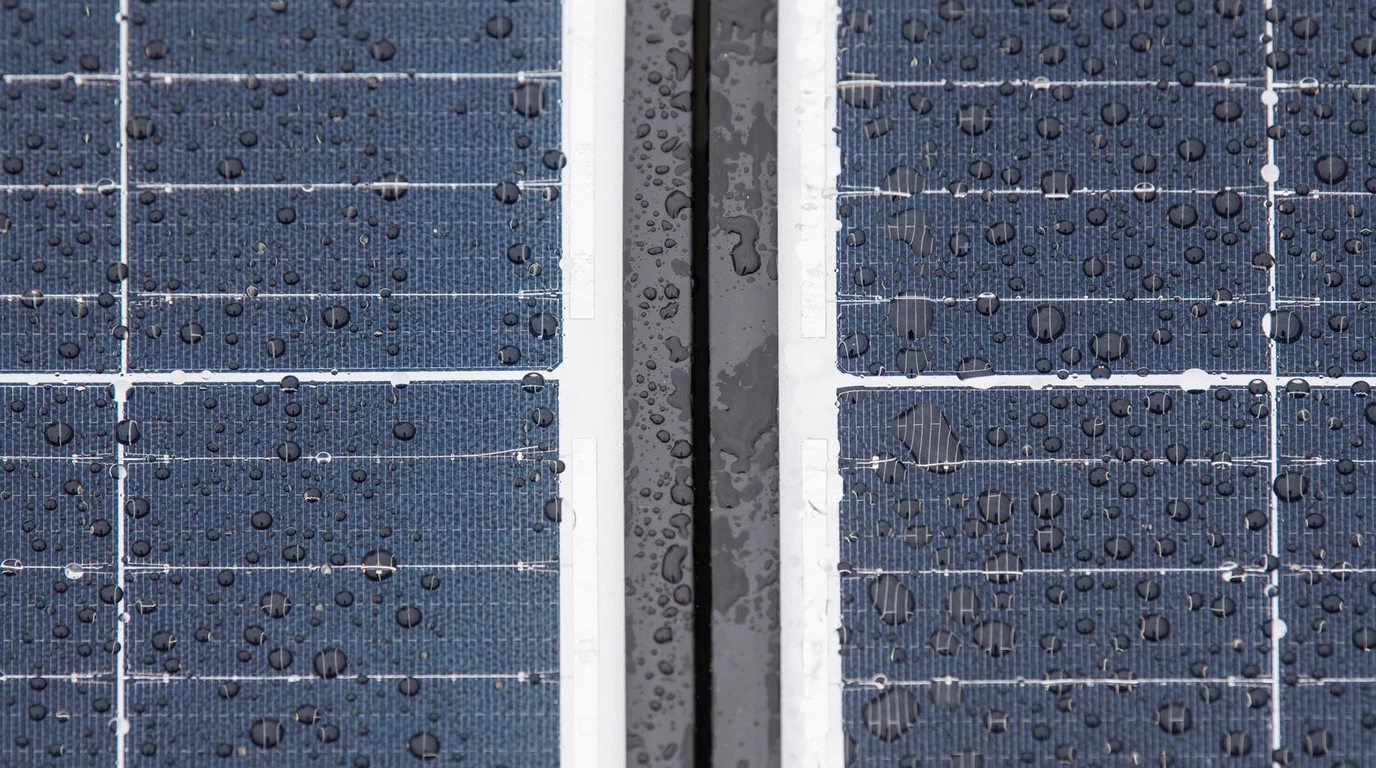
In northern climates across Canada and the northern United States, the single most common objection to residential and commercial solar adoption is winter weather. Skeptics routinely point to snow-covered rooftops in January and declare photovoltaic (PV) systems useless: “Why spend $25,000 on solar when it will be buried under two feet of snow for four months of the year?”
For standard monofacial solar panels (modules with an opaque white or black backsheet that only absorb light from the front), heavy snow cover is indeed an operational obstacle. A thick blanket of wet snow blocks 99% of incoming solar photons, dropping array output to zero. However, the rapid mainstream adoption of bifacial solar technology—panels engineered with dual-glass encapsulation that generate electricity from both the front and rear faces—has completely revolutionized winter solar economics.
Far from being an energy-destroying impediment, snow is actually the highest-yield environmental reflector on planet Earth. When engineered with proper racking height and tilt geometry, bifacial solar panels exploit winter snowfields to produce astonishing power spikes, generating up to 20% to 35% more winter energy than legacy monofacial arrays while actively accelerating natural snow shedding.
How Do Bifacial Solar Panels Work in Heavy Snow?
Direct Answer: Bifacial solar panels utilize transparent glass backsheets and dual-sided silicon cells to absorb diffuse light reflected from the ground (albedo). Because fresh snow reflects 80% to 90% of sunlight, the rear face of the panel begins generating electricity even when the front is completely snow-covered. This electrical current produces internal resistive heat that warms the panel, melting the bottom interface of snow and triggering rapid gravitational sliding.
To understand the thermodynamic and optical physics at play, we must explore ground albedo. Albedo represents the reflection coefficient of a surface, measured on a scale from 0.0 (total light absorption) to 1.0 (total light reflection). Standard summer ground surfaces have relatively poor albedo: green grass reflects only 15% to 25% of sunlight (albedo 0.15–0.25), dark asphalt reflects 10% to 15%, and gravel reflects approximately 20%.
Fresh, powdery snow, however, has an extraordinary albedo rating of 0.80 to 0.90. This means that 80% to 90% of all incoming global horizontal irradiance (GHI) that hits the snow-covered ground is immediately bounced back upward into the atmosphere. For a bifacial panel tilted toward the sun, its underside is exposed to a blinding wash of high-intensity reflected photons.
The Self-Clearing Thermodynamic Mechanism: The “Bifacial Melt Effect”
The most fascinating aspect of winter bifacial engineering is the self-clearing feedback loop. On a standard monofacial panel buried under six inches of snow, zero light penetrates to the silicon cells. The panel remains completely dormant, cold, and inert. Because the glass surface stays below freezing, the snow can remain stuck to the module for days or weeks until ambient air temperatures climb well above freezing.
On a bifacial installation, the physics are entirely different:
- Immediate Rear Generation: Even with six inches of snow piled on the front glass, the rear glass face is completely clear and exposed to the high-albedo snow-covered ground below. The rear cells immediately begin producing electricity—typically 15% to 30% of nameplate rated power.
- Internal Joule Heating: As direct current (DC) flows through the internal cell interconnects and busbars, electrical resistance generates a small amount of waste heat (Joule heating). The temperature of the encapsulated silicon rises by 2°C to 5°C (4°F to 9°F) above the surrounding ambient air temperature.
- Interfacial Boundary Melting: This internal heat conducts forward through the front tempered glass. The microscopically thin layer of snow resting directly against the front glass surface melts into liquid water, destroying the adhesive friction bond between the ice crystals and the glass.
- Gravitational Avalanche: Once the water boundary layer forms, gravity takes over. The entire snow sheet slumps and slides off the panel in large slabs, leaving the front glass spotless and fully exposed to direct sunlight within hours of a winter storm.
| Array Design Parameter | Monofacial Standard Array | Bifacial System (Optimized) | Winter Performance Delta |
|---|---|---|---|
| Ground Albedo Utilization | 0% (Opaque Backsheet) | 75% – 85% Rear Bifaciality | Captures 80%+ snow reflection |
| Post-Storm Snow Clearing Time | 3 to 10 days (Waits for warm air) | 4 to 12 hours (Thermal shedding) | Recovers full generation days faster |
| Winter Energy Yield (Dec–Feb) | Baseline (100%) | 122% – 135% of Baseline | +22% to +35% seasonal energy gain |
| Optimal Mounting Geometry | Flush roof or low tilt (20°–30°) | Elevated ground mount (35°–45°) | Steep tilt sheds snow; height clears drifts |
| Module Degradation (Glass-Glass) | 0.50% / year (Plastic backsheet) | 0.35% / year (Dual tempered glass) | Dual-glass eliminates moisture ingress & PID |
The Three Engineering Traps That Ruin Bifacial Winter Gains
While the physics of bifacial snow performance are flawless, thousands of homeowners fail to achieve these gains because of crude mechanical installation errors:
1. The Flush-Mount Roof Trap
Installing bifacial panels flush against a dark asphalt shingle roof is completely pointless. If there is only three inches of clearance between the back of the panel and a black shingle surface, ambient light cannot enter the underside, and zero albedo is reflected. Furthermore, on a flush-mounted roof, sliding snow accumulates immediately at the bottom edge of the array, damming up and burying the bottom row of cells. Bifacial technology requires either an elevated ground mount or a high-tilt metal/white membrane roof with at least 12 to 24 inches of clearance to function.
2. The Insufficient Ground Clearance Trap (Snow Damming)
In regions that receive heavy snowpacks (such as Ontario, Quebec, Minnesota, or New York), a ground-mount racking system with its lowest edge positioned only 18 inches off the soil will quickly become useless. When 15 inches of snow falls on the ground, sliding snow from the panel face has nowhere to go. It piles up against the bottom lip of the module, forming an ice dam that halts further shedding and causes severe cell mismatch shading. A winter-optimized ground array must maintain a minimum bottom clearance of 36 to 48 inches above ground level.
3. The Under-Tilted Solar Geometry Trap
Many residential solar contractors optimize racking tilt strictly for peak summer generation (typically 20° to 28° in mid-latitudes). At a shallow 25° tilt, snow cannot overcome the coefficient of friction against smooth tempered glass. The snow clings stubbornly, forcing the system to wait days for solar melting. In northern climates, tilting arrays at 35° to 45° (or utilizing seasonal adjustable tilt racking) allows snow to slide off instantly while aligning perpendicular to low-angle winter sunlight.
When bifacial panels capture direct sunlight and high ground albedo simultaneously on a frigid -10°C day, instantaneous power output can surge to 125% of nameplate capacity. Avoid clipping bottlenecks by exploring our analysis on Solar Inverter Clipping & Optimal DC-to-AC Ratios.
The Actionable Field Playbook: Designing for Winter Albedo
If you are planning a clean energy solar installation in a region subject to freezing temperatures and snow, follow this rigorous engineering design checklist:
- Specify Dual-Glass Bifacial Modules: Demand glass-glass bifacial panels (such as Canadian Solar BiHiKu, Longi Hi-MO, or Aptos Dual-Glass) featuring bifaciality factors of 75% to 80%. Glass-glass construction prevents backsheet degradation, resists snow load flexing up to 5,400 Pa, and provides decades of dual-sided generation.
- Design Racking for a 40° Winter Tilt: In northern latitudes (42°N to 52°N), engineer your ground mount or flat-roof ballast system to maintain a 38° to 42° tilt angle. This ensures that the shear gravitational force of wet snow exceeds the static friction coefficient of wet glass.
- Enforce 42-Inch Minimum Ground Clearance: Ensure the bottom edge of your lowest module sits at least 3.5 feet (1.06 m) above finished grade. This provides ample physical clearance for fallen snowbanks to accumulate without choking the lower cell strings.
- Eliminate Racking Shadow Obstructions on Rear Glass: Select racking structures engineered specifically for bifacial modules that place crossbars and torque tubes along the module frame perimeter rather than directly behind the active cell matrix. Shading the rear face with torque tubes creates severe hot-spot thermal stress and eliminates up to 30% of rear albedo harvest.
- Do NOT Scrape Solar Panels with Shovels: Never use metal shovels, stiff brooms, or abrasive chemical de-icers to clear snow from panels. Scraping micro-scratches the anti-reflective silica coating on the glass, permanently reducing light transmission. Trust the bifacial Joule-heating mechanism to shed snow naturally.
Snow is not the enemy of solar energy; poor engineering is. The combination of fresh snow’s 0.85 albedo, sub-zero silicon semiconductor efficiency gains (photovoltaic cells produce higher voltage at colder temperatures), and bifacial dual-glass architecture makes winter one of the most productive seasons on a per-sun-hour basis. If you live in a snowy climate, forget monofacial flush-mount arrays. Invest in an elevated, steeply tilted bifacial ground mount or elevated commercial racking system, and let the snowfield below your array become a massive, free photon amplifier.
Winter energy efficiency requires optimizing both heat pump balance points and solar array albedo. Explore sub-zero winter performance in our study on Dual-Fuel Heat Pump Cutoff Temp: Balance Point Guide.
Rooftop array safety requires reliable module-level electronics. Audit winter snow-shedding and electrical yield in our teardown on Solar Rapid Shutdown: NEC 690.12 Module-Level Safety.