
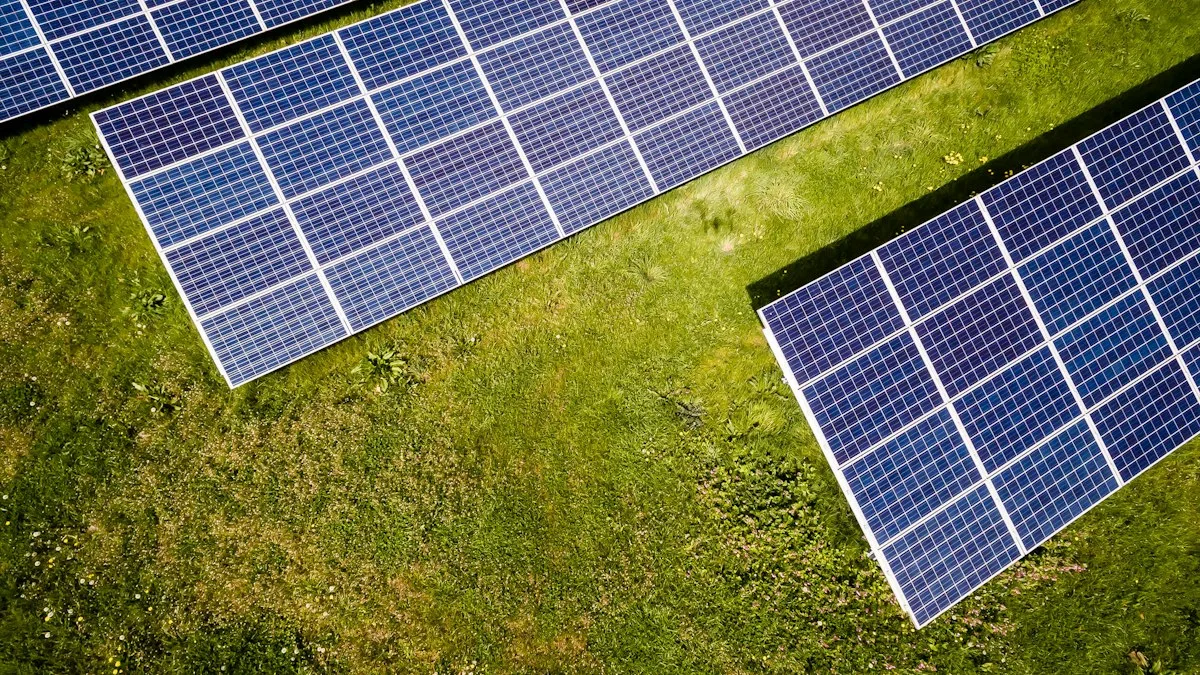
The Physics of Rear-Side Photovoltaic Excitation
Traditional monofacial solar modules feature an opaque backsheet, converting only direct and diffuse light striking the front surface into direct current electricity. In contrast, bifacial modules utilize dual-glass (glass-on-glass) construction and transparent bifacial solar cells (such as N-type TOPCon or Heterojunction / HJT). By absorbing reflected photons from the ground surface through the rear glass pane, these modules achieve bifaciality factors ranging from 70% to 90% (meaning the rear face produces up to 90% of the rated front-side power when exposed to equivalent irradiance).
| Ground Surface / Albedo Type | Surface Albedo Coeff (%) | Expected Rear-Side Energy Gain | Annual Production Boost |
|---|---|---|---|
| Green Grass / Bare Soil | 15% – 20% | +5% to +8% | +6.2% kWh / Year |
| Gray Concrete / Crushed Gravel | 25% – 35% | +9% to +14% | +11.8% kWh / Year |
| White TPO Membrane / White Crushed Rock | 55% – 65% | +16% to +22% | +18.5% kWh / Year |
| Fresh Snow Cover (Winter Conditions) | 75% – 85% | +22% to +30% | +25.4% kWh / Winter Peak |
Critical Installation Variables: Height, Tilt, and Inverter Sizing
Extracting the full economic potential of bifacial modules requires precise physical array engineering. If panels are mounted flush against a pitched residential asphalt roof, rear-side gain drops to zero because reflected light cannot reach the back of the cell. Optimal bifacial yield requires three parameters:
- Ground Clearance (Elevation): Mounting panels at least 36 to 48 inches above ground level allows diffuse ground reflections to spread uniformly across rear cell strings without self-shading.
- Racking Optimization: Utilizing specialized single-axis trackers or portrait-oriented purlin racking that avoids blocking the center of the rear glass pane.
- Inverter DC/AC Ratio Overhaul: Because bifacial modules routinely produce 110% to 125% of their nameplate STC wattage in high-albedo conditions, solar designers must properly size string inverters and microinverters to avoid clipping excess generation.
Albedo Ground Refinement: Surface Materials and Spectral Yield
Extracting maximum rear-side energy generation from bifacial photovoltaic modules requires rigorous engineering of the ground surface directly beneath and surrounding the solar array. The albedo coefficient represents the fraction of total solar irradiance reflected by the ground surface back into the atmosphere.
Natural ground cover—such as standard green grass or dark damp soil—possesses a low albedo coefficient between 15% and 20%, limiting rear-side bifacial yield to roughly 5% to 7%. Solar microgrid engineers dramatically amplify production by installing high-reflectance surfacing materials across the ground footprint:
- White Crushed Limestone / Dolomite Gravel: Applying a 3-inch layer of clean white crushed stone elevates surface albedo to 50%–60%, boosting rear-side power output to +15% to +18%.
- White Geotextile Ground Cover: Installing UV-stabilized white woven ground fabrics suppresses weed growth while maintaining consistent 55% albedo reflectivity with minimal maintenance.
- Winter Snow Albedo Amplification: Fresh snow cover delivers the highest natural albedo on earth (75% to 85%). On elevated ground mounts, winter snow reflection illuminates the rear cells intensely, generating electrical current that warms the module from behind and accelerates snow shedding from the front glass surface.
DC-to-AC Inverter Sizing to Prevent Bifacial Clipping Losses
In traditional monofacial solar system design, engineers routinely specify a DC-to-AC ratio (Inverter Loading Ratio / ILR) of 1.25 to 1.30 (pairing 10 kW of DC solar panels with an 8 kW AC inverter). Because standard monofacial panels rarely produce 100% of their rated standard test condition (STC) wattage due to real-world heat and atmospheric losses, slight midday clipping is an acceptable economic trade-off.
Applying traditional monofacial sizing ratios to bifacial arrays causes severe energy loss. In high-albedo ground conditions, a bifacial solar array rated at 10 kW front-side capacity regularly generates 11.5 kW to 12.5 kW of actual DC power during clear midday peaks. If paired with an undersized inverter, the excess 2.5 kW of clean solar power is forcibly clipped and wasted. Bifacial ground-mount microgrids require conservative DC-to-AC ratios between 1.05 and 1.15 to capture the full economic value of ground-reflected photons.
Single-Axis Tracking Synergy with Bifacial Photovoltaics
The ultimate performance frontier for commercial and estate-scale solar microgrids is the integration of bifacial modules with single-axis astronomical solar trackers. In a fixed ground-mount array, rear-side generation is constrained during early morning and late afternoon hours due to low solar elevation angles and self-shading.
Single-axis tracking systems rotate modules from east to west to follow the sun’s trajectory across the sky. By maintaining an optimal angle of incidence on the front face throughout the day, the rear surface receives continuous, unobstructed ground reflections. Field telemetry from the National Renewable Energy Laboratory (NREL) confirms that pairing bifacial modules with single-axis tracking and high-albedo surfacing increases total annual energy harvest by an astonishing 32% to 38% compared to static monofacial ground mounts, dramatically reducing the Levelized Cost of Energy (LCOE).
Frequently Asked Questions About Bifacial Solar Panels
Are bifacial solar panels worth it on pitched shingle roofs?
Generally no. Flush mounting leaves less than 4 inches of clearance beneath the modules, blocking reflected light and preventing rear-side power generation. Bifacial panels are best reserved for ground mounts, carports, or flat roofs.
Do bifacial panels perform better in snow?
Significantly better. Snow on the ground creates an ultra-high albedo reflection (up to 85%), exciting the rear cells and heating the module from behind, which accelerates the melting and shedding of snow from the front glass.
Are dual-glass bifacial panels more durable than monofacial panels?
Yes. Dual-glass construction eliminates polymer backsheets that degrade from UV exposure, providing superior mechanical load resistance, zero moisture ingress, and 30-year linear performance warranties.
While engineering rooftop solar array compliance and rapid shutdown electronics, evaluate ground-mount performance in Solar Rapid Shutdown: NEC 690.12 Module-Level Safety.