
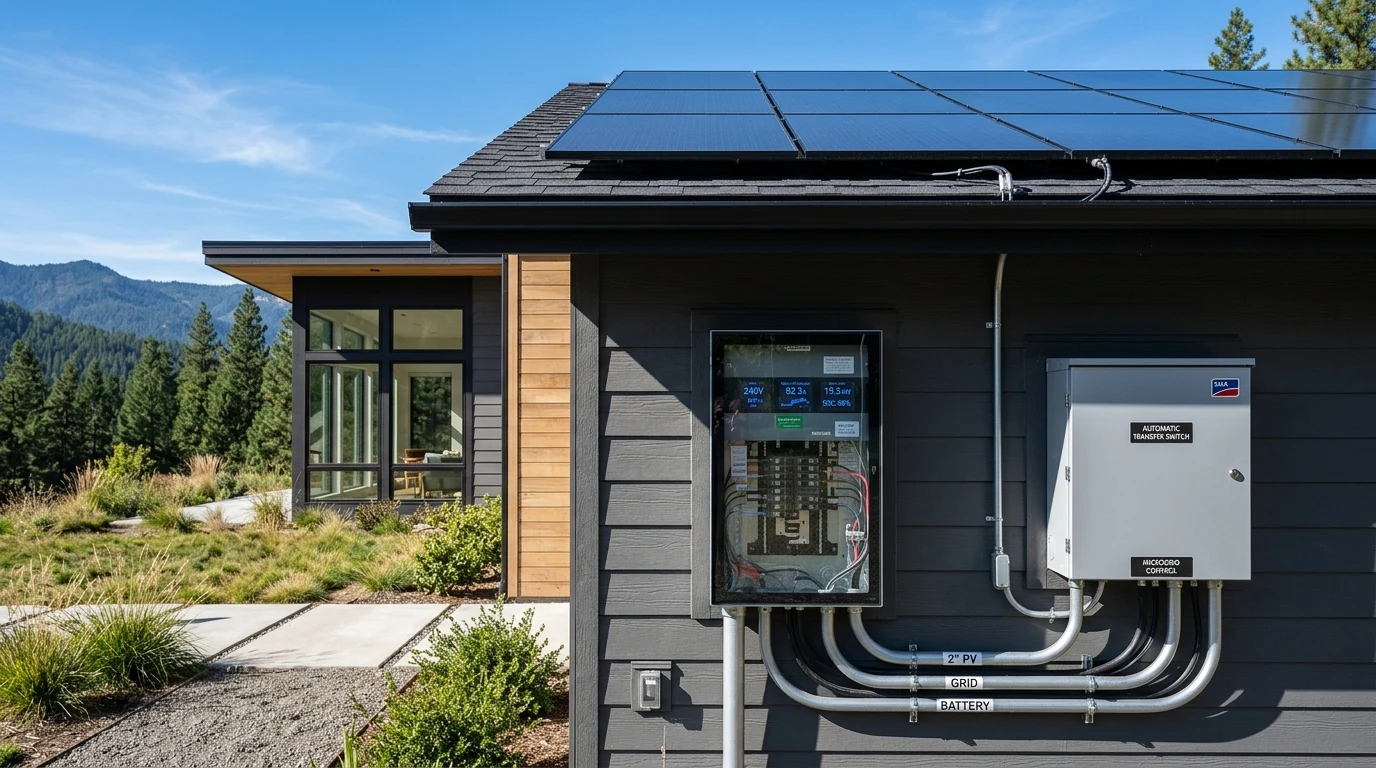
When the commercial electric grid goes dark, an islanded residential solar microgrid must perform a feat of precision electrical engineering: it must establish an autonomous reference voltage on a de-energized bus, regulate fluctuating solar generation, and withstand severe inductive motor starting surges. This operational milestone is known as black start.
While marketing brochures frequently promise ‘seamless whole-home backup,’ real-world off-grid transitions often collapse the moment a major residential appliance attempts to start. The culprit is rarely continuous running wattage; it is inrush current—the instantaneous surge of electrical current drawn by inductive electric motors (heat pump compressors, well pumps, air conditioners, sewage ejectors) during the first 100 milliseconds of rotor acceleration. In this technical guide, we dissect black-start sequences, locked rotor amperage (LRA) physics, grid-forming inverter surge envelopes, and electronic soft-starter integration.
- Inrush Current Multiplier: Single-phase inductive motors draw 5 to 7 times their full-load running amperage (FLA) during across-the-line startup, quantified on equipment nameplates as Locked Rotor Amps (LRA).
- Inverter Surge Limitations: Solid-state residential battery inverters feature strict thermal overload limits, typically sustaining 150% to 200% of rated capacity for only 5 to 10 seconds before tripping on overcurrent protection.
- Soft Starter Remediation: Installing microprocessor-controlled soft starters on heat pump compressors reduces starting LRA by 65% to 70%, allowing a modest 10 kW battery system to reliably start a 4-ton HVAC compressor during a black start.
What Is Inrush Current and Locked Rotor Amperage (LRA)?
When an induction motor is at rest, the magnetic field within the stator windings has not yet established rotation. The only impediment to current flow is the pure DC resistance of the copper winding wires, which is extraordinarily low (often less than 0.5 ohms). As voltage is applied across the contactor, Ohm’s law dictates an enormous immediate surge of electrical current.
As the rotor accelerates and matches the synchronous frequency of the AC sine wave, the spinning rotor generates counter-electromotive force (back-EMF), which opposes incoming line voltage and reduces running current down to normal Full Load Amps (FLA, typically 12A to 18A). The critical engineering problem is that this transition takes between 100 and 300 milliseconds—a brief interval, but more than enough time to collapse the voltage of an islanded solid-state inverter.
Inverter Capacity vs. Motor Starting Demands
The table below models typical residential motor loads, comparing standard running amperage (FLA) against locked rotor amperage (LRA) and evaluating the required battery inverter surge rating to start each appliance independently:
| Residential Inductive Appliance | Running Current (FLA) | Starting Current (LRA) | Peak Surge Power (240V) | Standard Inverter Feasibility |
|---|---|---|---|---|
| 3-Ton Single-Stage Heat Pump | 16.7 Amps (4.0 kW) | 82.0 Amps LRA | 19,680 Watts (19.7 kW) | Trips single 7.6 kW inverter |
| 3-Ton Heat Pump + Micro-Air Soft Start | 16.7 Amps (4.0 kW) | 26.0 Amps (Peak) | 6,240 Watts (6.2 kW) | Starts easily on single 7.6 kW unit |
| 1.0 HP Deep Well Water Pump | 9.8 Amps (2.3 kW) | 48.0 Amps LRA | 11,520 Watts (11.5 kW) | Requires 10 kW+ continuous inverter |
| Variable-Speed Inverter Heat Pump | 12.5 Amps (3.0 kW) | 0 Amps LRA (True Soft Start) | 3,000 Watts (Ramps from 0W) | Zero inrush; 100% microgrid friendly |
The utility grid absorbs an 82-amp surge effortlessly because it behaves like an infinite electrical bus with tens of thousands of mega-volt-amperes (MVA) of rotating mass behind it. But a residential battery inverter utilizes solid-state silicon MOSFETs or IGBTs. If current through these semiconductor switches exceeds their maximum junction temperature threshold, the inverter’s protection firmware trips the system offline within milliseconds to avoid physical transistor vaporization.
The Mechanics of Electronic Soft Starters
For homes with existing single-stage or two-stage central air conditioners and heat pumps, installing an electronic soft starter (such as the Micro-Air EasyStart or Hyper Engineering SureStart) is the single most effective hardware upgrade to ensure black-start survival.
Unlike basic ‘hard start kits’ (which merely consist of a start capacitor and potential relay that actually increase total starting current to force a stuck compressor into rotation), an electronic soft starter is an intelligent micro-controller device wired in series with the compressor run and start windings:
- Ramp-Up Voltage Control: The soft starter utilizes solid-state thyristors (triacs) to slice the incoming AC voltage waveform, ramping voltage smoothly from 40% to 100% over the first 100 to 300 milliseconds.
- Adaptive Current Learning: Over the first five starts, the onboard microprocessor analyzes the specific mechanical resistance of the compressor scroll or piston, dynamically tuning the injection angle to optimize torque without excess amp draw.
- Resulting 65% LRA Reduction: A compressor with a brutal nameplate rating of 82A LRA drops down to a gentle 24A to 28A peak demand, eliminating the loud physical ‘thud’ and light flicker associated with HVAC startup.
Dead-Bus Synchronization and Black-Start Sequencing
When recovering from a full blackout where the battery must re-energize a dead house, smart load management architecture dictates a staggered boot protocol:
- Bus Energization (T+0s): The grid-forming battery inverter closes its internal contactor, establishing nominal 120/240V AC at exactly 60.0 Hz across the critical loads panel.
- Base Load Absorption (T+5s): Refrigerator control boards, network routers, and LED lighting loads turn on, drawing standard steady-state wattage (typically 400W to 800W).
- Interlocked HVAC Delay (T+30s to T+180s): Smart thermostats and electrical panels (like SPAN or Schneider Pulse) enforce a mandatory 3-minute compressor lockout. This allows refrigerant pressures across the heat pump expansion valve to equalize fully before attempting compressor startup, cutting startup torque requirements in half.
- Solar Inverter Re-Synchronization (T+300s): In AC-coupled configurations, the solar inverters wait for a mandatory 5-minute utility reconnect timer (IEEE 1547 compliance) to verify voltage stability before waking up and contributing solar energy to the microgrid.
Never buy a residential battery storage system based strictly on continuous kilowatt capacity. If your home relies on a central heat pump or well pump, check the equipment nameplate for ‘Locked Rotor Amps (LRA)’. If that number exceeds 50A and your system has a single 7.6 kW or 10 kW battery inverter, your microgrid will fault and trip on the very first subzero startup during a blackout. Install an electronic soft starter on your compressor today—for $350 in hardware, you transform an aggressive 80A inductive shock into a gentle 25A glide, guaranteeing your black-start microgrid actually stays online when you need it most.
Before designing an islandable microgrid or sizing inrush surge capacities, examine how circuit-level smart panels eliminate main service bottlenecks. Read our technical analysis: Leviton Smart Panels vs SPAN: 200A Home Retrofit Math.
Before evaluating winter electrical surge demands on residential backup power, model how outdoor coil frost and reverse-cycle defrost cycles impact power draw. Read our forensic analysis: Heat Pump Defrost Cycle: Reverse Cycle COP Penalties.