
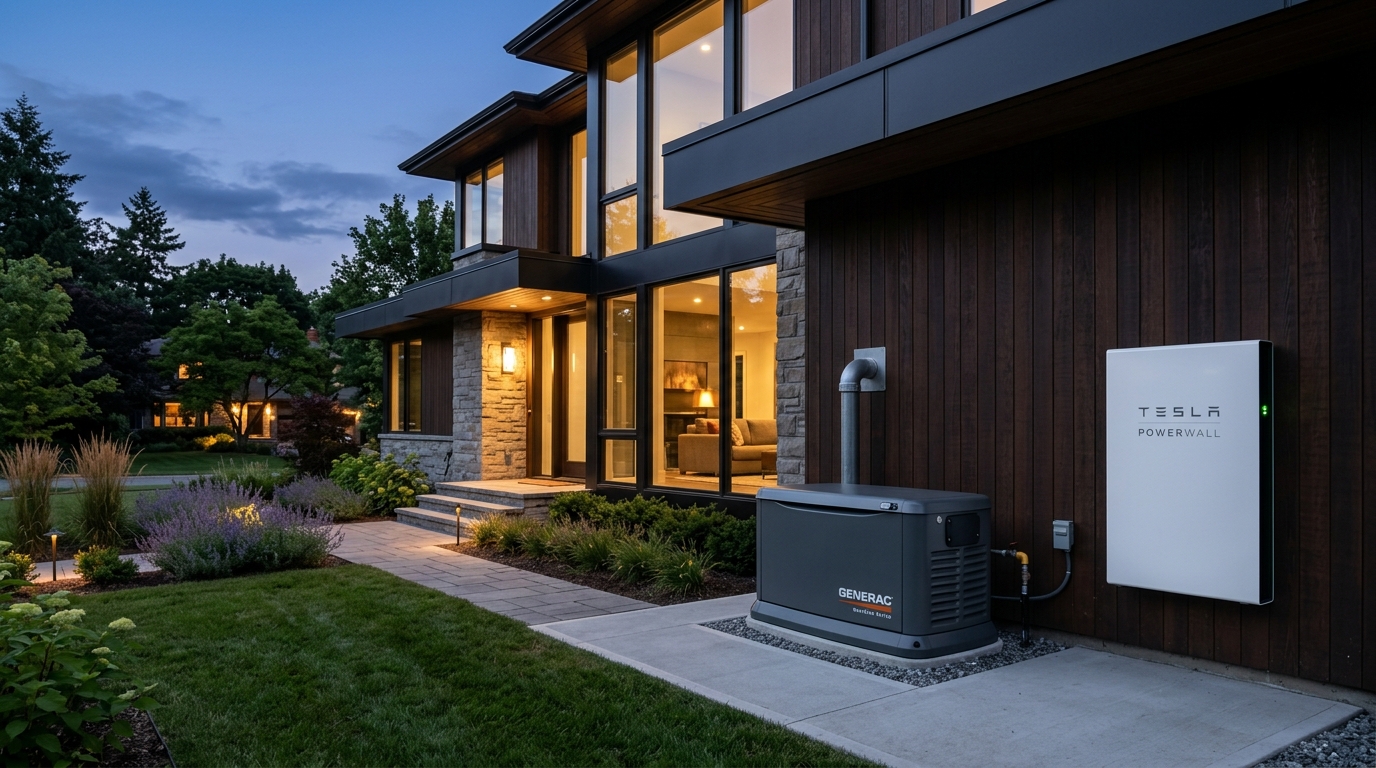
- 10-Year Total Cost of Ownership (TCO): A 20kWh LFP battery system paired with solar achieves complete capital breakeven in 6.8 years; a standby gas generator represents a pure sunk cost with lifetime fuel/maintenance overhead exceeding $9,500.
- Switchover Latency: LFP storage provides sub-16ms microgrid islanding (zero reboot on computers/electronics); generators require 10 to 30 seconds of engine cranking before transfer.
- Fuel Vulnerability: Natural gas pipeline pressure drops during extreme winter grid freezes (e.g. Winter Storm Uri) stall standby generators when power is needed most.
When preparing residential infrastructure against grid instability, catastrophic weather, and utility power outages, homeowners face a fundamental architectural choice: install a traditional fossil-fuel standby generator (Generac, Kohler, Cummins) or deploy a Lithium Iron Phosphate (LFP) home battery storage system (Tesla Powerwall 3, Enphase IQ Battery 5P, FranklinWH).
For decades, natural gas and propane generators were the unquestioned standard for whole-home resilience. In 2026, shifting utility tariff structures, solar pairing economics, and silent solid-state reliability have fundamentally disrupted that equation. This connects directly with our analysis of Enphase V2H bidirectional charging and solar lease buyout traps.
10-Year TCO Economics: Sunk Capital vs. Active Energy Arbitrage
While an automatic standby generator requires a lower upfront capital outlay ($12,000 to $16,000 installed), it produces zero daily revenue and incurs ongoing fuel and maintenance costs. An LFP battery system ($18,000 to $24,000 before federal tax credits) operates daily to eliminate peak time-of-use tariffs, paying for itself in under 7 years when paired with solar.
A standby generator is an insurance policy that sits idle 99% of the year. Every week, it exercises its internal combustion engine for 15 minutes, consuming fuel. Every 100 to 200 operating hours, it requires oil changes, spark plug replacements, and valve adjustments. In contrast, an LFP battery cycles daily, charging from low-cost solar or off-peak grid rates and discharging during expensive peak hours.
| Performance Metric | Standby Generator (22kW Gas) | LFP Battery System (20kWh Storage) | Forensic Assessment |
|---|---|---|---|
| Upfront Installed Cost | $13,500 – $17,000 | $18,000 – $24,000 (Gross) / $12,600 (Net with ITC) | 30% federal clean energy tax credit levels upfront gap |
| Switchover Transfer Speed | 10 to 30 seconds (Engine crank delay) | Sub-16ms (Instantaneous solid-state relay) | Batteries prevent PC reboots, clocks resetting, and WiFi drops |
| Operating Sound Profile | 65 to 72 dBA at 23 feet | < 35 dBA (Whisper quiet inverter fans) | Generators frequently violate municipal night noise bylaws |
| Daily Economic Value | $0.00 (Sits idle) | $2.50 – $6.50/day in TOU tariff arbitrage | Battery generates $900 – $2,200 annual utility bill savings |
People Also Ask: Generator vs Battery Backup
Can a home battery run an entire house including central AC?
Yes. Modern energy storage systems like the Tesla Powerwall 3 deliver 11.5kW of continuous output with a 185A locked-rotor motor start capacity, effortlessly starting and running 4-ton and 5-ton central air conditioning units or cold-climate heat pumps without requiring external soft starters.
How long will an LFP battery last in an extended multi-day blackout?
When paired with rooftop solar, an LFP battery can operate indefinitely in off-grid microgrid mode. During the day, solar powers home loads and recharges the battery to 100%; at night, the battery powers critical loads. Without solar, a 20kWh battery running basic critical loads (refrigeration, lights, router, furnace blower) will last 24 to 36 hours.
Can you combine a generator and a battery system?
Yes. Hybrid architectures (such as FranklinWH or Enphase with generator integration modules) allow a small 10kW generator to recharge the battery bank only when solar is unavailable, running the engine at peak efficiency for 2 hours rather than continuous 24/7 noise.
Standby fossil-fuel generators are 20th-century technology attempting to solve 21st-century grid challenges. When factoring in the 30% federal clean energy tax credit and daily time-of-use utility arbitrage, Lithium Iron Phosphate (LFP) storage provides superior economic returns, zero maintenance headaches, sub-16ms switchover, and complete energy independence when paired with solar. Invest in silent, solid-state resilience.