
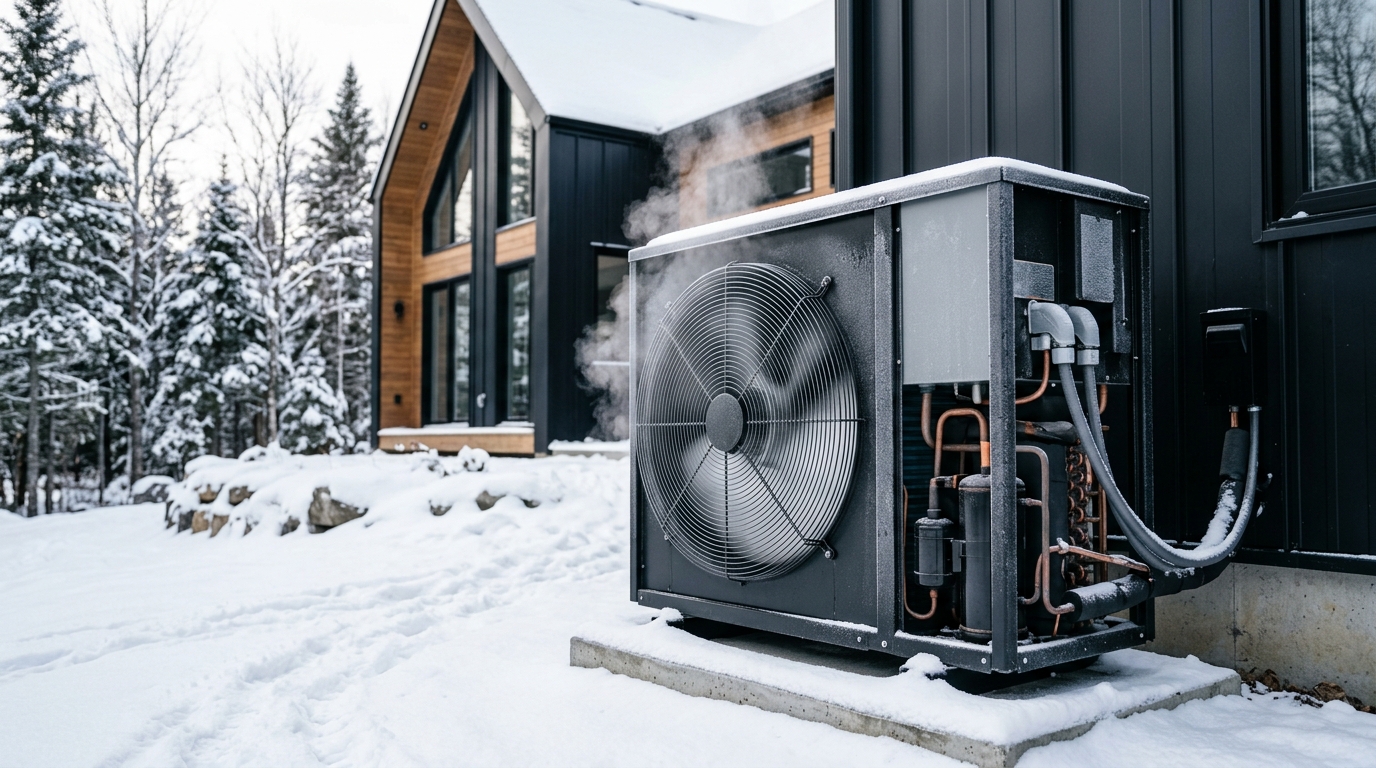
As residential electrification accelerates across northern climates, heat pumps have emerged as the primary weapon against volatile natural gas, propane, and fuel oil heating bills. Yet, an alarming percentage of cold-climate heat pump installations throughout Canada and the northern US fail to deliver their promised operating efficiencies. Homeowners frequently open their mid-winter utility bills to discover shocking $800 to $1,400 monthly charges. The root cause is rarely the thermodynamic technology itself—it is the widespread HVAC industry practice of improper system sizing, aggressive compressor short-cycling, and uncalibrated auxiliary electric resistance backup staging.
- The Oversizing Short-Cycling Trap: Sizing an inverter-driven heat pump for extreme design-day heating peaks (e.g. -30°C) without examining minimum turndown ratios causes the compressor to short-cycle continuously during 80% of winter days (between -5°C and +7°C), slashing seasonal COP from 3.2 down to 1.7 and destroying compressor lifespans.
- Auxiliary Strip Heat Parasitism: Unmonitored 10 kW to 15 kW resistive backup elements that engage automatically during routine defrost cycles or minor thermostat setback recoveries consume electricity at a COP of exactly 1.0, instantly quadrupling grid peak demand.
- Electrical Service Bottlenecks: Pairing a 4-ton heat pump with a 15 kW auxiliary heat kit requires up to 75 amps of dedicated electrical capacity, frequently forcing an unneeded $4,000 200-amp panel upgrade that smart staging controls could avoid.
Heat Pump Thermodynamic Sizing: Inverter Modulating Range vs. Fixed Sizing
Traditional single-stage gas furnaces were historically oversized by 50% to 100% with negligible efficiency penalties. Applying that same legacy rule-of-thumb sizing to modern variable-capacity inverter heat pumps is an engineering catastrophe. Modulating systems deliver peak seasonal efficiency when they run continuously at low-to-moderate speeds, matching real-time building envelope heat loss.
| Design Configuration | Sizing Strategy | Seasonal Heating COP | Annual Electrical Draw (2,400 sq ft) |
|---|---|---|---|
| Oversized 4-Ton (Rule of Thumb) | Sized to cover 100% load at -30°C; 15 kW strip | 1.85 (Heavy short-cycling & strip engage) | 14,800 kWh ($2,516 CAD @ $0.17/kWh) |
| Right-Sized 3-Ton (Manual J Audit) | Matches load at -12°C; staged 8 kW backup | 2.75 (Continuous modulation, minimal strips) | 9,950 kWh ($1,691 CAD @ $0.17/kWh) |
| Vapor-Injection Cold Climate (Hyper-Heat) | 100% capacity maintained to -15°C; 5 kW lock | 3.10 (High sub-zero COP retention) | 8,820 kWh ($1,499 CAD @ $0.17/kWh) |
| Net Financial Savings: Right-Sizing | Engineered Manual J vs. Oversized | +48% Higher Efficiency | $1,017/year in avoided grid power |
The Auxiliary Resistance Lockout Architecture
The single greatest operational hazard in cold-climate heat pump deployments is improper thermostat staging. Most default smart thermostats (including standard Ecobee or Nest profiles) treat electric resistance auxiliary heating as a simple booster. If the indoor temperature is more than 1.5°C below setpoint—which happens naturally when returning from a night setback—the thermostat fires the 10 kW resistive heating coils immediately, even if the outdoor compressor is capable of satisfying the load.
To eliminate this parasitic draw, HVAC technicians must configure an Auxiliary Heat Lockout Temperature (typically between -12°C and -18°C depending on building envelope balance points). Above this lockout threshold, the electric resistance strips are physically forbidden from firing during normal heating cycles. Furthermore, pairing the system with intelligent energy monitoring ensures whole-home peak load remains within panel constraints.
Smart Load Shedding & Whole-Home Microgrid Integration
When electrifying an older home, the combined load of a cold-climate heat pump, electric water heater, and EV charger frequently triggers an expensive service upgrade to 200 amps. Homeowners can circumvent this bottleneck by integrating smart electrical panels that dynamically deprioritize non-essential loads during sub-zero cold snaps.
For technical breakdowns of cold-climate equipment, explore our teardown of cold-climate heat pumps at -25°C and vapor-injection compressors, as well as our forensic analysis of subzero COP curves and vapor-injection efficiency. To manage residential electrical panel limits, review our comparison of smart electrical panels: SPAN vs. Schneider Pulse.
Never allow an HVAC contractor to install a heat pump based on square footage rules-of-thumb or your old furnace’s BTU rating. Demand a room-by-room Manual J heat loss calculation. A properly sized modulating heat pump that operates continuously across its 20% to 100% capacity curve—backed by a strict thermostat lockout on auxiliary resistance strips—will slash winter operating costs by over 40% while delivering far superior indoor humidity and thermal comfort.
People Also Ask
Why is my heat pump electric bill so high in the winter?
High winter heat pump bills are almost always caused by auxiliary electric resistance heat strips turning on prematurely. When resistive heat strips engage, they consume electricity at a coefficient of performance (COP) of 1.0, using up to three times more power than the heat pump compressor itself.
What is heat pump short-cycling and why is it bad?
Short-cycling occurs when a heat pump is oversized for the home. The system blasts heat quickly, satisfies the thermostat within minutes, and shuts down, only to restart a short time later. This frequent on-off cycling prevents the system from running at high-efficiency modulating speeds, increases wear on compressor bearings, and spikes electricity usage.
At what temperature should auxiliary heat turn on?
For modern cold-climate heat pumps, auxiliary heat should generally be locked out from operating until outdoor temperatures drop below -12°C to -15°C (10°F to 5°F). In well-insulated homes with vapor-injection compressors, auxiliary heat may not be needed until -20°C (-4°F).