
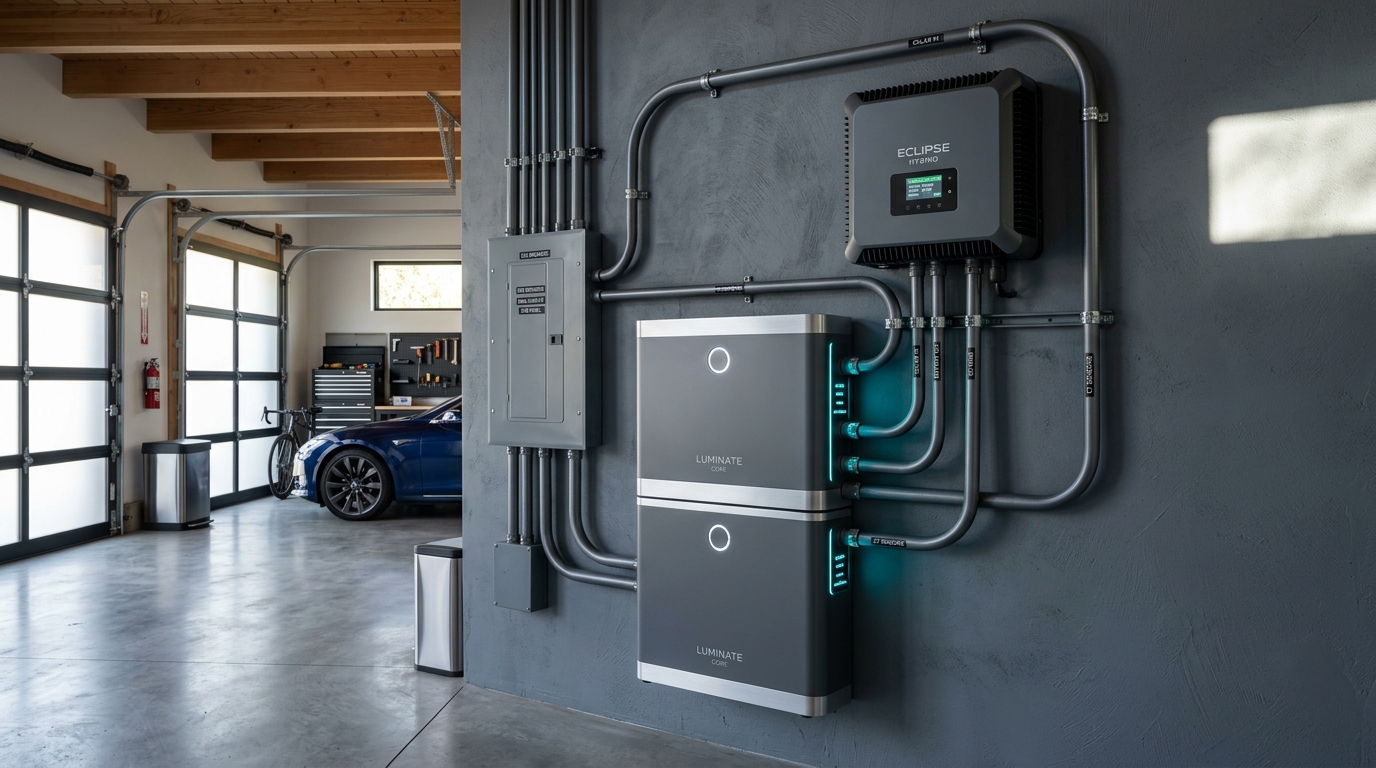
The residential energy storage system (ESS) sector has diverged into two competing design philosophies. The Tesla Powerwall 3 represents the monolithic, DC-coupled approach—combining 13.5 kWh of storage with an integrated 20 kW DC solar inverter and an industry-leading 11.5 kW continuous output. Conversely, the Enphase IQ Battery 5P embodies distributed, modular AC coupling—utilizing ultra-safe Lithium Iron Phosphate (LFP) chemistry and six redundant microinverters per 5.0 kWh unit. Choosing between them requires balancing raw discharge power against partial-shading resiliency and chemistry longevity.
What Is the Difference Between Tesla Powerwall 3 and Enphase IQ Battery 5P?
The fundamental difference between the Tesla Powerwall 3 and Enphase IQ Battery 5P is system coupling and chemical architecture. The Powerwall 3 is a DC-coupled system with an integrated 20 kW solar string inverter and NMCA chemistry, delivering massive 11.5 kW continuous power. The Enphase 5P is an AC-coupled system using inherently safe LFP chemistry and modular 3.84 kW microinverters, providing zero single-point-of-failure reliability and superior partial-shading solar harvest.
When selecting a home energy storage system in 2026, homeowners frequently evaluate battery capacity in isolation. However, in electrical engineering, a battery is only as capable as its inverter interface. A 13.5 kWh battery restricted to a 5 kW continuous discharge cannot start a central air conditioning compressor or heat pump without soft-start accessories.
As analyzed in our teardown of AC vs. DC Coupling in Residential Microgrids, the Powerwall 3 was engineered from the ground up to solve motor inrush limitations, delivering an extraordinary 185A Locked Rotor Amperage (LRA) surge capability. Yet this raw horsepower comes with distinct architectural trade-offs.
Cell Chemistry Comparison: NMCA vs. Lithium Iron Phosphate (LFP)
One of the most consequential engineering divergences lies beneath the casing: the underlying battery chemistry.
As documented in our clinical chemistry audit on LFP vs. NMC Home Battery Storage, Lithium Iron Phosphate (LFP) boasts superior thermal runaway resistance (thermal decomposition threshold at ~270°C vs ~210°C for nickel-rich chemistries). The Enphase IQ Battery 5P utilizes prismatic LFP cells warrantied for 6,000 complete 100% depth-of-discharge cycles (equating to over 15 years of daily cycling with 80%+ retained capacity).
Tesla opted for a proprietary high-density Nickel-Manganese-Cobalt-Aluminum (NMCA) chemistry in the Powerwall 3. While NMCA allows Tesla to pack 13.5 kWh into a compact 287-pound footprint, it carries a 10-year warranty pegged to 70% retention and requires liquid thermal management to regulate cell degradation under high ambient garage temperatures.
| Engineering Parameter | Tesla Powerwall 3 | Enphase IQ Battery 5P (Single Unit) | Enphase 5P (2-Unit Stack: 10 kWh) |
|---|---|---|---|
| Usable Energy Capacity | 13.5 kWh | 5.0 kWh | 10.0 kWh |
| Continuous Power Output | 11.5 kW (Grid & Islanded) | 3.84 kW | 7.68 kW |
| Peak Motor Surge (LRA) | 185 Amps (Sub-second) | 32 Amps (3-second) | 64 Amps (3-second) |
| Integrated Solar Inverter | Yes (20 kW DC solar input, 6 MPPTs) | No (AC-coupled to rooftop IQ8s) | No (AC-coupled) |
| Battery Cell Chemistry | NMCA (Nickel-Manganese-Cobalt-Al) | Prismatic LFP (Lithium Iron Phosphate) | Prismatic LFP |
| Warrantied Cycles / Retention | 10 Years / 70% Retention | 15 Years (6,000 Cycles) / 80% | 15 Years (6,000 Cycles) / 80% |
| Round-Trip Efficiency (RTE) | 89.0% | 90.0% | 90.0% |
Architecture Trade-Off: Monolithic DC String vs. Distributed AC Redundancy
The choice between these two market leaders comes down to rooftop dynamics and reliability engineering:
When Tesla Powerwall 3 Wins:
- New Full-System Solar Installs: Because the Powerwall 3 integrates a massive 20 kW DC solar inverter with six independent Maximum Power Point Trackers (MPPTs), you do not need to purchase separate rooftop microinverters or string inverters. This slashes equipment acquisition and labor costs significantly.
- Whole-Home High-Inrush Loads: With 11.5 kW continuous output from a single box and 185A peak motor surge, a single Powerwall 3 can seamlessly back up an entire house, including a 4-ton heat pump and electric dryer, without adding a second battery. As detailed in our audit on Whole-Home Battery Islanding and Microgrid Interconnect Devices, Tesla’s Gateway 3 executes sub-second solid-state transitions that keep sensitive electronics running uninterrupted.
When Enphase IQ Battery 5P Wins:
- Complex Roofs with Heavy Shading: If your roof has multiple gables, chimney shadows, or tree coverage, central DC string inverters suffer from module mismatch loss. Enphase’s rooftop IQ8 microinverters optimize every solar panel independently, out-producing DC strings by 8% to 15% annually in shaded environments.
- Mission-Critical Hardware Redundancy: Each Enphase 5P battery contains six independent IQ8D microinverters. If an internal inverter fails, the remaining five continue operating with zero downtime. If a central inverter in a Powerwall 3 fails, the entire solar array and home battery backup are incapacitated until a field replacement unit is dispatched.
If you have an unshaded, south-facing roof and demand maximum raw discharge power to run heavy heat pump compressors from a single enclosure, the Tesla Powerwall 3 is an unprecedented value engineering triumph. However, if your roof suffers from complex shading, or if you demand the non-negotiable fire safety and 15-year/6,000-cycle durability of Lithium Iron Phosphate chemistry with zero single point of failure, a multi-unit Enphase IQ Battery 5P microgrid remains the premier engineering choice for residential energy resilience.