
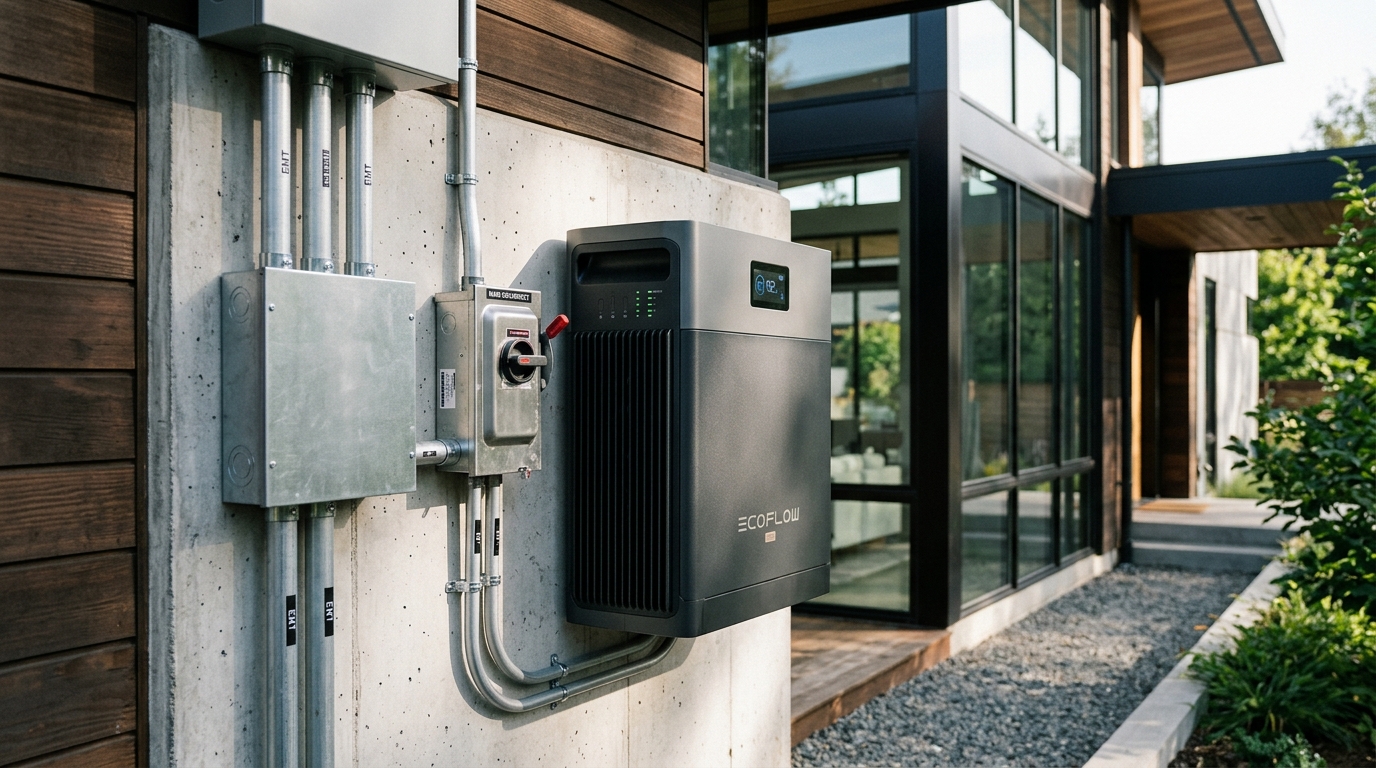
- Chemical Safety & Thermal Runaway: Lithium Iron Phosphate (LiFePO4 / LFP) exhibits an intrinsic thermal runaway threshold of 270°C (518°F) with zero oxygen release during cell breakdown. By contrast, Nickel Manganese Cobalt (NMC 811/622) self-heats at 150°C to 210°C, releasing volatile oxygen radicals that sustain combustion even in oxygen-depleted enclosures.
- Cycle Degradation & Longevity: Tier-1 prismatic LFP architectures guarantee 6,000 to 8,000 full equivalent cycles to 80% state of health (SOH) under standard 1C cycling. NMC residential packs degrade to 70% SOH after 2,500 to 3,500 cycles, effectively cutting economic service life in half under aggressive Time-of-Use (TOU) arbitrage.
- The Sub-Zero Temperature Penalty: Neither chemistry can be charged below 0°C (32°F) without catastrophic metallic lithium plating. However, LFP suffers severe internal impedance escalation below -10°C, requiring integrated internal resistive heating pads that consume 5% to 12% of stored capacity during extreme winter blackouts.
- Inductive Motor Surge Resilience: Modern microgrid resilience depends on starting high-surge HVAC inductive loads. When paired with cold-climate heat pumps at sub-zero temperatures, distributed LFP microinverter topologies deliver significantly higher peak locked rotor amperage (LRA) tolerance than centralized NMC battery inverters.
The residential energy storage landscape is experiencing a definitive, irreversible chemical bifurcation. For the past decade, consumer marketing celebrated energy density above all else. Driven by electric vehicle requirements where every kilogram of curb weight penalizes range, early residential battery offerings relied heavily on high-energy-density Nickel Manganese Cobalt (NMC) chemistries. However, when bolting 20 to 60 kilowatt-hours (kWh) of chemical energy to the wall of an occupied residence or inside an attached garage, gravimetric energy density is a secondary engineering priority. Safety, cycle endurance, thermal stability, and levelized storage economics reign supreme.
Today, Lithium Iron Phosphate (LiFePO4 / LFP) has emerged as the clear engineering standard for stationary residential microgrids. Pioneered by manufacturers like Enphase (IQ Battery 5P), FranklinWH, and even adopted by Tesla in newer utility-scale Megapacks, LFP trades slight physical bulk for unmatched chemical resilience. Yet, widespread marketing oversimplifications have left homeowners confused regarding cold-weather performance, round-trip efficiency (RTE), and actual fire safety margins. To make a sound capital investment, systems architects must evaluate the raw thermodynamic and electrochemical realities.
LFP vs. NMC Home Batteries: Which Chemistry Is Safer and Longer Lasting?
Lithium Iron Phosphate (LFP) is significantly superior to Nickel Manganese Cobalt (NMC) for stationary residential storage. LFP’s olivine crystal lattice has a thermal runaway temperature of 270°C (compared to 210°C for NMC) and releases zero oxygen during thermal decomposition, eliminating catastrophic fire risks. Furthermore, LFP delivers 6,000 to 10,000 full charge cycles at 80% DoD (15–20 year lifespan) compared to just 2,500 to 3,500 cycles for NMC.
The fundamental performance and safety divergence between LFP and NMC originates at the sub-microscopic crystalline level. A battery’s cathode structure dictates how lithium ions de-intercalate during charging and re-insert during discharge:
- LFP (LiFePO4) – The Phospho-Olivine Framework: In an LFP cathode, iron and phosphate ions form a robust, three-dimensional olivine crystal lattice. The covalent phosphorus-oxygen (P-O) chemical bond is extraordinarily strong (∼400 kJ/mol). Even under severe physical puncture, crushing, or electrical overcharge up to 4.2V per cell, the P-O bond remains intact. Because oxygen is chemically locked inside the phosphate polyanion, the cell cannot release gaseous oxygen to feed internal combustion.
- NMC (LiNixMnyCozO2) – The Layered Metal Oxide Lattice: NMC utilizes a layered hexagonal lattice where lithium ions sit between transitional metal oxide planes. While this enables high energy density (>250 Wh/kg vs. LFP’s 140–170 Wh/kg), the metal-oxygen bonds are inherently weak. When an NMC cell overheats or suffers internal short-circuiting, the lattice undergoes an irreversible phase transition, breaking down and releasing free, highly reactive gaseous oxygen (O2) directly into the hot organic liquid electrolyte.
2. Thermal Runaway Forensics: UL 9540A Testing Reality
Thermal runaway is the catastrophic sequence where an internal exothermic reaction generates heat faster than it can be dissipated to the surrounding ambient environment. The engineering divergence between these two chemistries is not subtle; it is a matter of basic thermodynamics:
Under standardized UL 9540A thermal runaway fire propagation testing, an NMC cell pushed beyond its operating envelope initiates self-heating at approximately 150°C to 180°C. Once triggered, internal temperatures violently escalate to >800°C within fractions of a second, jetting toxic flammable gases (hydrogen, carbon monoxide, methane, and hydrogen fluoride). Because the cathode actively supplies its own oxygen, traditional class ABC fire extinguishers cannot extinguish an NMC thermal runaway cascade.
By comparison, LFP cells possess a self-heating trigger threshold of 270°C (518°F). If forced into failure via extreme external heating, LFP undergoes endothermic decomposition: it vents non-oxygenated smoke, swells, and off-gasses without open flaming or thermal cascading to adjacent cells. For indoor residential mechanical rooms and residential garages sharing a structural wall with living quarters, LFP provides an unassailable margin of safety.
3. Engineering Data Matrix: LFP vs. NMC Electrochemical Audit
To evaluate residential storage systems objectively, systems engineers examine metrics across efficiency, degradation, thermal operating envelopes, and lifecycle financial cost:
| Engineering Parameter | Lithium Iron Phosphate (LFP) | Nickel Manganese Cobalt (NMC) | Residential Architectural Verdict |
|---|---|---|---|
| Thermal Runaway Temperature | 270°C (518°F) | 150°C – 210°C | LFP will not release self-sustaining oxygen during thermal breakdown. |
| Cycle Life to 80% SOH | 6,000 – 8,000 Cycles | 2,500 – 3,500 Cycles | LFP lasts 15–20 years of daily 100% Depth-of-Discharge (DoD) cycling. |
| Cell Voltage Nominal / Range | 3.2V (Flat 3.0V – 3.3V curve) | 3.6V – 3.7V (Sloping curve) | LFP maintains constant inverter voltage; requires Coulomb-counting BMS. |
| Round-Trip Efficiency (RTE) | 89% – 92% (AC-to-AC) | 90% – 94% (AC-to-AC) | NMC holds a slight 1–2% efficiency edge due to lower internal cell resistance. |
| Cold Charging Floor | 0°C (Requires heating pads) | 0°C (Requires heating pads) | Both chemistries plate lithium if charged below freezing; LFP impedance rises faster. |
| Levelized Cost of Storage (LCOS) | $0.07 – $0.11 / kWh-cycled | $0.18 – $0.26 / kWh-cycled | LFP’s 6,000+ cycle life crushes NMC in amortized levelized economics. |
Can You Charge an LFP Home Battery in Freezing Temperatures?
No, an LFP battery must never be charged below 0°C (32°F) without internal thermal pre-heating. While LFP cells can safely discharge down to -20°C (-4°F), forcing charging current into cold LFP cells causes lithium ions to plate as metallic dendrites on the graphite anode, permanently destroying storage capacity and causing internal short circuits. Premium home batteries (like Enphase IQ 5P and Tesla Powerwall 3) integrate internal resistance heating pads to warm cells above 5°C before charging.
A widespread misconception among homeowners in northern climates is that LFP batteries cannot function in sub-zero environments. The physics requires precise distinction between discharging and charging:
Discharging in Sub-Zero Conditions
LFP batteries can safely discharge power down to -20°C (-4°F). However, as temperatures drop below 0°C, the viscosity of the liquid organic electrolyte increases, slowing lithium ion diffusion and elevating internal cell resistance (IR). Under a heavy discharge load at -15°C, this internal resistance induces significant voltage sag. Furthermore, internal I²R resistive heating warms the cells during discharge, creating a natural self-heating feedback loop.
The Charging Barrier: Lithium Dendrite Plating
Charging an LFP cell below 0°C (32°F) is strictly prohibited by every certified Battery Management System (BMS). Because cold temperatures impede lithium ions from intercalating into the graphite anode structure, forced current causes lithium ions to deposit on the surface of the anode as pure metallic lithium. This metallic plating creates razor-sharp lithium dendrites that pierce the microscopic polyolefin separator, causing instantaneous internal dead shorts, permanent capacity loss, and severe fire risk.
To operate in cold garages or outdoor enclosures, modern architectural LFP systems integrate internal resistive heating blankets. When solar PV power arrives on a freezing winter morning, the BMS routes 100% of incoming energy into the internal heating element. Only after cell core thermistors confirm temperatures have surpassed +5°C (41°F) does the BMS open the charge contactor. In a severe winter storm, heating elements consume 1.0 to 2.5 kWh daily just to maintain operational readiness—an energy overhead that must be engineered into your initial sizing calculations.
5. System Architecture: Distributed Microinverters vs. Centralized High-Voltage DC
The chemistry debate cannot be divorced from inverter topology. Residential energy storage is broadly categorized into two competing design philosophies:
1. Distributed Modular LFP (The Enphase IQ Battery Model)
Systems like the Enphase IQ Battery 5P utilize low-voltage (48V nominal) prismatic LFP cells coupled directly to multiple microinverters embedded inside the battery chassis. This delivers three distinct architectural advantages:
- Zero Single Point of Failure: If an individual inverter stage fails, the remaining parallel units continue islanding the home microgrid without service interruption.
- Superior Locked Rotor Amperage (LRA) Surge: A bank of three 5P batteries can deliver up to 76.8 amps of peak motor starting current for 3 seconds—effortlessly starting variable-speed heat pump compressors without requiring external soft starters.
- Safe Low-Voltage DC: Eliminates dangerous 400V DC high-voltage cabling running across residential attic and wall spaces.
2. Centralized High-Voltage (The Tesla Powerwall Model)
Centralized systems utilize a single high-voltage (350V–450V DC) battery pack wired into a centralized string inverter. While this offers slightly higher round-trip efficiency by bypassing double AC-DC conversion stages, an inverter board failure disables the entire backup system. Furthermore, earlier Powerwall generations relied on liquid-cooled NMC cells, trading LFP’s inherent chemical safety for compact wall packaging.
For stationary residential energy storage, Lithium Iron Phosphate (LFP) is the undisputed engineering victor. The negligible advantage in physical space offered by NMC cannot justify its lower thermal runaway safety margin, aggressive cycle degradation, and elevated levelized cost per kilowatt-hour. If you are building a resilient home microgrid designed to withstand 15 to 20 years of daily solar self-consumption, Time-of-Use rate arbitrage, and harsh winter sub-zero backup, specify certified LFP chemistry with integrated thermal management. Energy density belongs in vehicles; chemical immortality belongs in your home.
Architectural Update (2026): For a direct hardware and surge capacity comparison of market-leading LFP implementations, read our detailed forensic teardown: Enphase IQ Battery 5P vs. Tesla Powerwall 3: AC vs. DC Coupling and Microgrid Surge.