
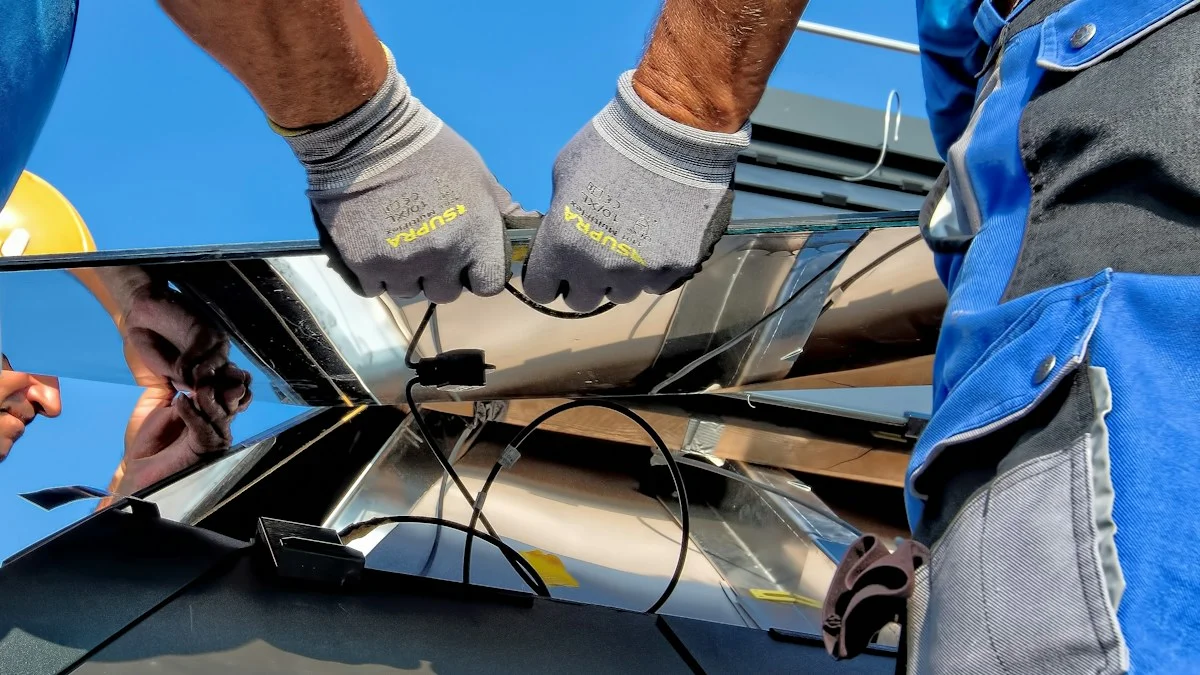
- Bifacial Bifaciality Factor: Premium dual-glass TOPCon bifacial modules boast an 80% to 85% rear-to-front power rating ratio.
- Albedo Yield Multiplier: In snowy cold-climate ground mounts (albedo 0.80–0.85), bifacial panels generate 22% to 27% more cumulative annual kilowatt-hours than monofacial panels.
- Mounting Height Requirement: Requires a minimum ground clearance of 0.8 to 1.2 meters to permit diffuse rear reflected radiation to reach back-side cells evenly.
How Do Bifacial Solar Panels Generate Energy from the Back Side?
Standard monofacial solar panels capture irradiance solely from the direct front angle. Any photons bouncing off the earth or underlying roof surface strike an opaque polymer backing and dissipate as waste heat. In contrast, modern n-type TOPCon (Tunnel Oxide Passivated Contact) and Heterojunction (HJT) bifacial cells possess symmetrical electrical contact grids on both front and rear surfaces.
The parameter that measures rear generation capability is the “bifaciality coefficient” (expressed as a percentage). If a 500-watt module has an 80% bifaciality factor, its rear side can generate up to 400 watts under equivalent front-side test conditions, as demonstrated across solar cell degradation benchmarks.
Ground Albedo Coefficients: Why Snow and White Gravel Maximize Output
In snowy northern latitudes, monofacial solar panels suffer massive winter production losses when snow blankets the front glass. Bifacial panels exhibit a unique self-clearing physical advantage: as diffuse light reflects off the surrounding snow pack onto the exposed rear glass, current begins flowing through the cells. This current generates subtle internal resistive heat, warming the module and accelerating snow slide-off from the front surface.
| Underlying Ground / Roof Surface | Albedo Reflection Factor | Measured Bifacial Energy Gain | Installation Suitability |
|---|---|---|---|
| Fresh White Snow (Winter) | 0.80 – 0.85 (80–85%) | +22% to +27% Energy Yield | Ground mounts in cold climates |
| White TPO / PVC Membrane Roof | 0.70 – 0.75 (70–75%) | +16% to +21% Energy Yield | Flat commercial / tilt-leg roofs |
| Light Crushed Limestone / Gravel | 0.35 – 0.40 (35–40%) | +10% to +14% Energy Yield | Standard rural ground-mount arrays |
| Green Grass / Soil / Turf | 0.18 – 0.22 (18–22%) | +6% to +8% Energy Yield | Residential lawn installations |
| Dark Asphalt Shingles | 0.08 – 0.12 (8–12%) | +1% to +2% (Negligible) | Flush-mounted rooftop (Contraindicated) |
Why Flush-Mounted Rooftop Bifacial Installations Make No Sense
To capture diffuse rear reflection, photons need geometric space to travel beneath the racking structure. Mathematical ray-tracing models indicate that ground mounts must maintain at least 30 to 48 inches of bottom clearance from the earth, paired with a generous tilt angle (30 to 45 degrees). Installing bifacial modules on flush sloped residential roofs simply wastes money on premium glass that never receives illumination, contrasting with solar shingle economics.
People Also Ask
Do bifacial solar panels cost more than standard panels?
In 2026, the price premium for bifacial modules has collapsed to nearly zero. Due to massive manufacturing scale of dual-glass TOPCon cells, bifacial panels cost only 1 to 2 cents per watt more than monofacial equivalents.
Are bifacial solar panels heavier?
Yes. Dual-glass bifacial modules use 2.0mm tempered glass on both sides, making them approximately 15% to 20% heavier (typically 60 to 70 lbs per 72-cell module) than monofacial panels with polymer backsheets.
How far off the ground should bifacial panels be mounted?
For optimal rear energy capture, the lowest edge of a ground-mount bifacial array should sit at least 30 to 36 inches (0.8 to 1.0 meter) above the ground.
Related High-Yield Solar Engineering:
To capture ground snow reflection and boost sub-zero winter production by up to 25%, read our comprehensive guide on Solar Panels in Winter: Snow Shedding, Rakes & Tilt Guide.