
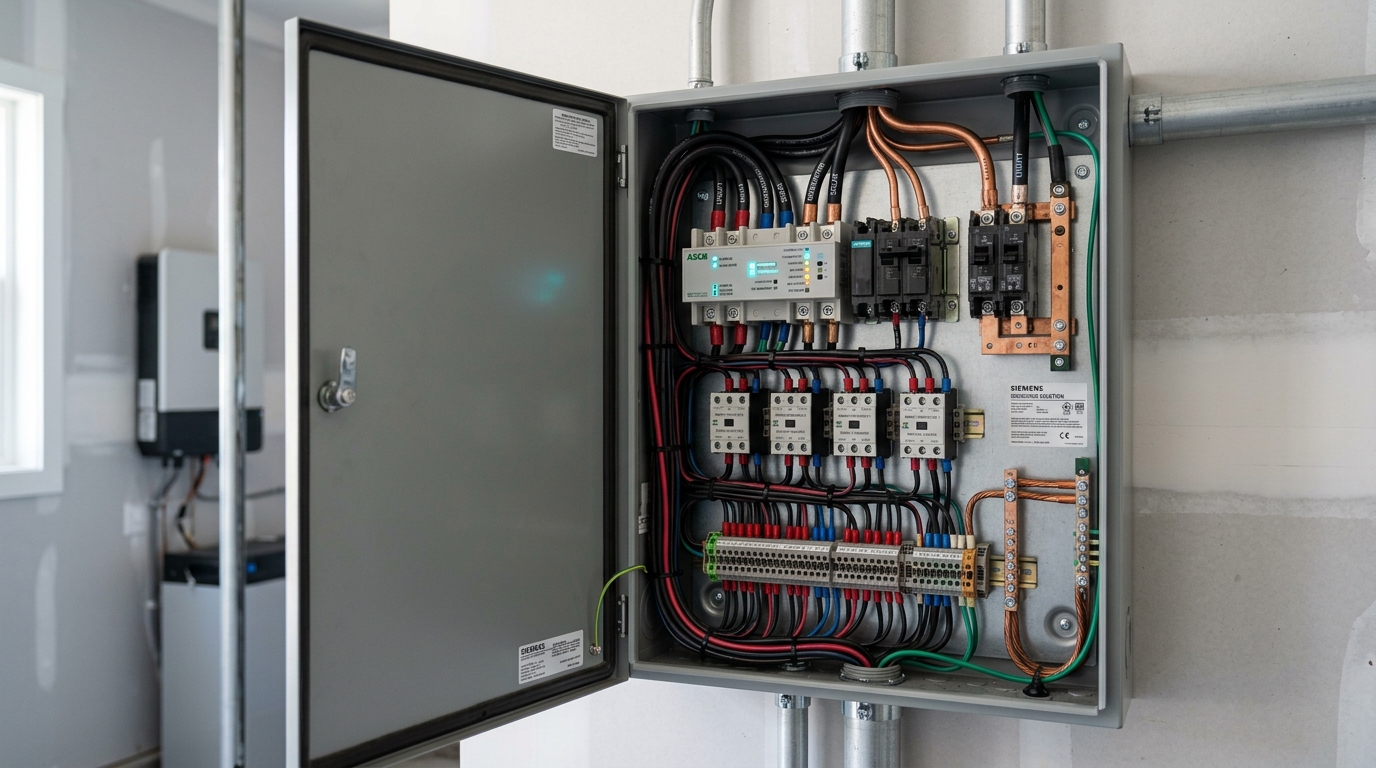
In the marketing brochures of residential clean energy providers, the transition from utility grid power to home battery backup is universally depicted as a frictionless, invisible event: a storm strikes, the neighborhood plunging into darkness, while your home remains brilliantly illuminated without a flicker. In the physical reality of residential electrical engineering, disconnecting a dwelling from a 240V utility transformer to establish an independent islanded microgrid is one of the most violent, complex switching maneuvers an electrical system can execute.
In 2026, the proliferation of whole-home residential battery systems—such as the Tesla Powerwall 3, Enphase IQ Battery 5P, FranklinWH aPower, and Schneider Home—has brought the physics of anti-islanding compliance (UL 1741 SA/SB) and transition latency to the forefront of electrical design. Whether an installation utilizes a legacy mechanical Automatic Transfer Switch (ATS), an electromechanical Microgrid Interconnection Device (MID), or a cutting-edge sub-cycle solid-state static transfer switch dictates whether your heat pumps, desktop PCs, and home servers survive a grid blackout seamlessly or crash instantly under voltage dropouts and arc-flash transients.
- Transition Latency Profiles: Mechanical generator ATS units require 100ms to 250ms to switch, guaranteeing electronics reboots. Modern MID contactors (e.g., Enphase System Controller 3, Tesla Backup Gateway 2) transition in 16ms to 32ms (roughly 1 to 2 AC cycles), while solid-state static switches achieve sub-4ms uninterruptible (UPS-grade) islanding.
- The Anti-Islanding Safety Mandate: Under IEEE 1547 and UL 1741 standards, an inverter MUST physically isolate from the utility grid within 2.0 seconds of an outage to prevent back-feeding high-voltage power onto downed distribution lines, protecting utility line workers from lethal electrocution.
- Neutral-Ground Bonding Switching: In grid-tied mode, a home’s neutral-to-ground bond must reside strictly at the primary utility service disconnect. During islanded operation, the MID or transfer switch must establish a switched neutral bond to create a separately derived system, preventing hazardous floating neutral voltages.
- Motor Inrush Current Handling: Air conditioning and heat pump compressors draw locked-rotor amps (LRA) between 4x and 7x running load amps (RLA). If an islanded battery inverter cannot deliver 150% to 200% surge capacity during the sub-cycle transition, voltage sags cause immediate inverter overload trips.
The Three Generations of Islanding Architecture
To evaluate battery backup resilience, system architects classify islanding hardware into three distinct technological tiers, each possessing unique electrical transition parameters:
1. Legacy Mechanical Automatic Transfer Switches (ATS)
Originally designed for fossil-fuel standby generators, traditional ATS units utilize motorized worm gears or mechanical solenoid actuators that physically throw heavy copper knife switches between utility and auxiliary lugs. Because moving mechanical parts must travel several inches, the transfer time spans 100ms to 300ms.
While adequate for incandescent lighting, refrigerators, and water pumps, this 200ms power drop is catastrophic for modern digital microprocessors. Desktop computers, Wi-Fi routers, NAS storage arrays, and digital appliance clocks instantly crash and reboot.
2. Microgrid Interconnection Devices (MID)
The contemporary industry standard for whole-home battery backup (e.g., Tesla Backup Gateway 2, Enphase System Controller 3G, SolarEdge Backup Interface). An MID utilizes high-speed, spring-loaded electromagnetic contactors combined with digital voltage/frequency sensing microcontrollers.
When the microcontroller detects abnormal utility grid frequency (outside 59.3 Hz – 60.5 Hz) or an acute voltage sag below 88% of nominal, it de-energizes the contactor coils, allowing spring-loaded contacts to break in 16ms to 32ms (1 to 2 AC cycles). High-quality PC power supplies with large hold-up capacitors (typically rated for 16ms hold-up) can often survive this transition without rebooting, though minor lighting flickers remain common.
3. Solid-State Static Transfer Switches (Sub-Cycle Relays)
The pinnacle of microgrid engineering, utilized in enterprise data centers and next-generation solid-state smart panels. Solid-state switches utilize pairs of inverse-parallel Silicon Controlled Rectifiers (SCRs) or high-power Gallium Nitride (GaN) transistors with zero moving mechanical parts.
Transition times drop to sub-4 milliseconds (less than one-quarter of an AC cycle). The utility grid is severed and the battery inverter assumes the sine-wave voltage reference so rapidly that sensitive lab equipment, servers, and medical monitors experience zero disruption.
Engineering Comparison Matrix: ATS vs. MID vs. Solid-State Relays
The following engineering matrix audits the technical performance, code compliance, and operational resilience of the three primary residential islanding technologies:
| Islanding Technology | Transfer Latency | Switching Mechanism | Electronics UPS-Grade? | Neutral-Ground Switching | Hardware Cost Tier |
|---|---|---|---|---|---|
| Mechanical Generator ATS | 100ms – 250ms | Motorized / Solenoid Knife Lug | No (Hard Reboots) | Optional 4-pole mechanical | Low ($600 – $1,200) |
| Electromechanical MID Contactor | 16ms – 32ms (1–2 cycles) | Spring-Loaded Electromagnetic Coil | Borderline (Depends on PSU) | Integrated Switched Bond Relay | Moderate ($1,800 – $2,800) |
| Solid-State Static Switch (SCR) | <4ms (Sub-cycle) | Thyristor / GaN Semiconductor | Yes (True Seamless UPS) | High-speed electronic bonding | Premium ($3,500 – $5,500) |
The Floating Neutral Hazard: Separately Derived Systems Explained
The most dangerous installation hazard in DIY or amateur whole-home battery installations involves neutral-ground bonding. According to the National Electrical Code (NEC Article 250) and Canadian Electrical Code (CEC Section 10):
- The Grid-Tied State: When connected to the utility, the neutral conductor must be bonded to the grounding electrode system at exactly ONE point: the main utility service disconnect. If a secondary bond exists inside the battery inverter, neutral current splits across the equipment grounding conductor (EGC), energizing the metal chassis of appliances with dangerous touch-potentials.
- The Islanded State: When the MID contactor opens, the home is physically severed from the utility transformer. If the neutral is not bonded inside the islanded microgrid, the home becomes a ‘floating neutral’ system. Phase-to-neutral voltages can wildly swing (e.g., 80V on Leg A and 160V on Leg B), instantly frying sensitive electronics and variable-speed heat pump control boards.
Modern MIDs solve this through an automated Neutral-Ground (N-G) bond relay. When the primary grid contactor opens, an auxiliary relay closes simultaneously, bonding neutral to ground inside the microgrid enclosure. When grid power restores, the auxiliary relay breaks milliseconds BEFORE the main grid contactor reconnects, guaranteeing code compliance across both states.
Grid Reconnection: Frequency Slew Rates & Phase Sync
While islanding receives the most attention, the process of grid reconnection requires equal precision. When utility power returns after an outage, it is often dirty, exhibiting voltage spikes and frequency instability as grid substations re-energize.
An intelligent MID enforces a mandatory 5-minute steady-state observation window. Once grid parameters stabilize, the battery inverter’s digital phase-locked loop (PLL) slowly adjusts its output frequency (slew rate matching) until the microgrid’s sine wave is perfectly in phase with the utility grid’s sine wave. Only when phase angle, voltage, and frequency match within microscopic tolerances does the contactor snap closed. Reconnecting out of phase would cause an instantaneous electrical explosion equivalent to a dead short-circuit across the inverter bridge.
Whole-home battery backup is only as reliable as the islanding device that controls it. Never accept a low-cost legacy mechanical ATS for a modern battery energy storage system—the 200ms transfer gap defeats the entire purpose of clean energy storage by crashing digital infrastructure and risking dangerous neutral float. For modern installations, an electromechanical Microgrid Interconnection Device (MID) with automated neutral bonding is the minimum acceptable baseline, while prosumers operating sensitive home labs, medical equipment, or mission-critical workstations should invest in sub-cycle solid-state static switching to achieve true, uncompromised UPS-grade resilience.
People Also Ask
What is the difference between an ATS and an MID in a battery system?
An Automatic Transfer Switch (ATS) is a mechanical switch originally designed for generators with a slow transition time (100–250ms). A Microgrid Interconnection Device (MID) is a smart, high-speed controller designed for solar and battery microgrids, transitioning in 16–32ms while managing anti-islanding safety, neutral-ground bonding, and phase synchronization.
Will my lights flicker when my home battery takes over during a power outage?
With standard MID systems (like the Tesla Backup Gateway or Enphase System Controller), you will typically notice a brief micro-flicker of roughly 16 to 30 milliseconds. While most lights flicker, desktop PCs and modern appliances usually stay powered without rebooting. True zero-flicker requires a sub-cycle solid-state transfer switch.
Why does a home battery need to disconnect from the grid during a blackout?
This is a mandatory safety requirement known as ‘anti-islanding’ (UL 1741). If a battery continued sending power to the grid during an outage, it would energize exterior power lines, posing a lethal electrocution risk to utility line workers repairing the grid.
What is floating neutral and why is it dangerous in battery backup?
A floating neutral occurs when an islanded system loses its connection to ground, causing voltage on the two 120V electrical legs to drift unevenly (e.g., 80V on one leg and 160V on the other). This voltage imbalance can destroy connected appliances, electronics, and heat pump motherboards.