
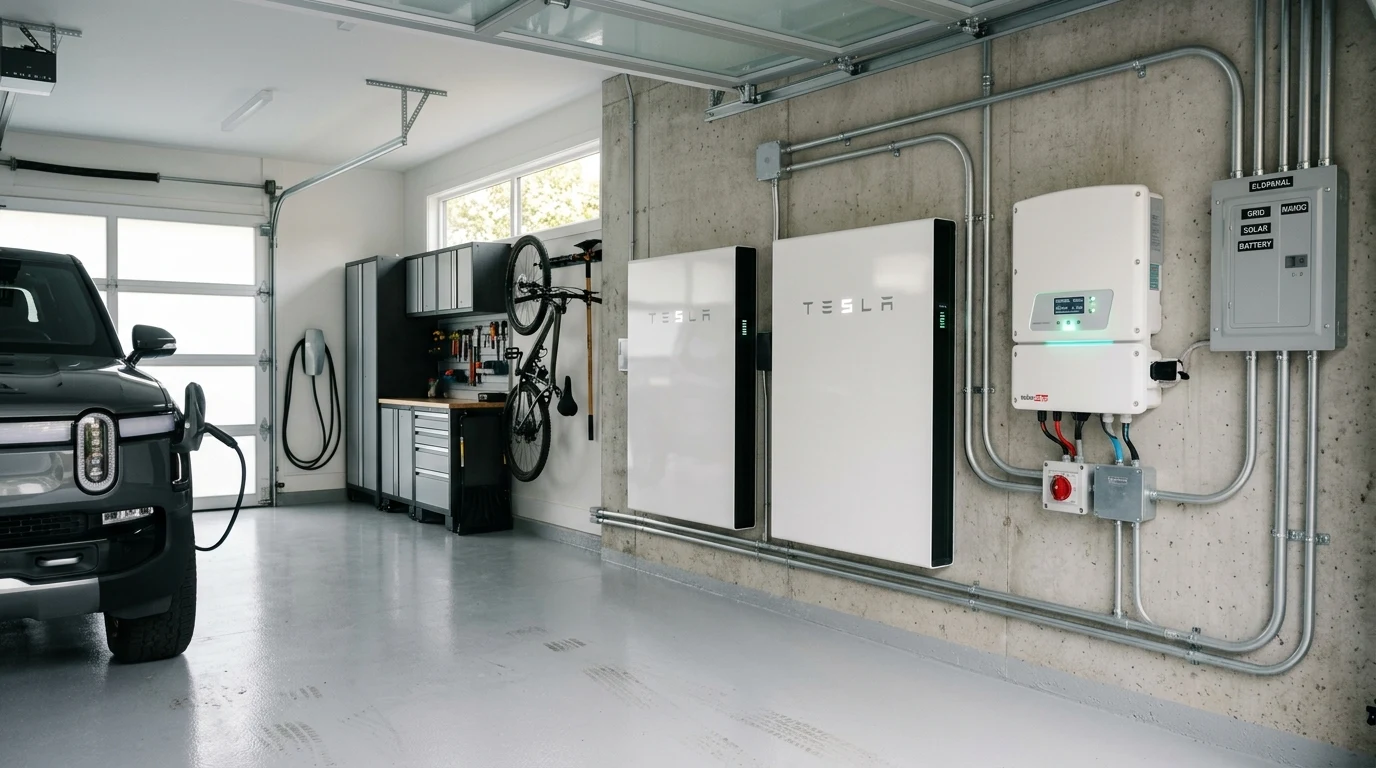
The architectural debate between AC-coupled and DC-coupled energy storage systems represents the fundamental engineering crossroads of modern residential solar electrification. When a homeowner decides to install a home battery—whether for grid resilience during winter storms, time-of-use tariff arbitrage, or maximizing self-consumption under post-net-metering regimes like California’s NEM 3.0—the coupling topology governs system round-trip efficiency, inverter clipping recovery, black-start reliability, and lifetime equipment return on investment (ROI).
Historically, AC coupling emerged as the dominant retrofit solution because it allowed existing grid-tied solar photovoltaic (PV) arrays to add battery storage without touching roof-mounted string inverters or microinverters. However, the rise of unified hybrid DC-coupled architectures—exemplified by systems like the Tesla Powerwall 3, Sol-Ark, and SolarEdge Home Hub—has challenged AC coupling’s supremacy by consolidating solar and battery power conversion into a single power stage. In this comprehensive forensic masterclass, we dissect the conversion physics, electrical topologies, microgrid islanding mechanics, and full lifecycle economics of AC versus DC coupled residential energy storage.
- Round-Trip Conversion Efficiency: DC-coupled storage systems achieve true wire-to-battery round-trip efficiencies (RTE) of 89% to 92% by charging directly from the DC solar bus. In contrast, AC-coupled systems suffer triple conversion losses (DC to AC to DC to AC), dropping real-world RTE to 80% to 84%.
- Solar Clipping Energy Recovery: DC-coupled hybrid inverters allow solar array oversizing ratios of 150% to 200% (DC-to-AC ratio) by routing excess midday solar energy directly into the battery pack before the inverter’s AC output limit is reached, capturing kilowatt-hours that AC-coupled systems permanently discard.
- Black-Start & Microgrid Islanding: True DC-coupled hybrid architectures can self-energize a dead bus directly from solar panels following an extended winter outage, whereas AC-coupled microgrids rely on frequency-shifting power controls (UL 1741 SA/SB) that can destabilize microinverters during rapid load shedding.
- Retrofit vs. Greenfield TCO: For existing homes with operational Enphase or SolarEdge systems, AC coupling avoids replacing fully functional inverters and rewiring roof conduit. For new ‘greenfield’ solar-plus-storage installations, DC coupling eliminates thousands of dollars in redundant inverter hardware and installation labor.
What Is the Fundamental Difference Between AC and DC Coupling?
To grasp the engineering trade-offs, one must trace the physical electrons as they journey from the rooftop photovoltaic silicon wafer to a household kitchen refrigerator. Solar cells generate Direct Current (DC) electricity natively through the photovoltaic effect. Similarly, electrochemical battery storage cells—whether Lithium Iron Phosphate (LiFePO4 / LFP) or Nickel Manganese Cobalt (NMC)—store and release energy purely as Direct Current. The alternating current (AC) grid and household electrical circuits, however, operate at 120V/240V 60Hz single-phase AC in North America.
Every time electricity passes through a power electronics stage—whether a DC-to-DC buck/boost converter, a Maximum Power Point Tracking (MPPT) optimizer, or a DC-to-AC inverter bridge—it encounters physical switching losses, magnetic core hysteresis, and thermal dissipation. Over the 15-to-25-year service life of an energy storage system, these percentage losses compound into thousands of kilowatt-hours of lost energy.
The Physics of Conversion Losses: The ‘Triple Inversion Tax’
The core thermodynamic disadvantage of AC coupling is the cumulative penalty commonly known among electrical engineers as the Triple Inversion Tax. Let us model the path of 10.0 kWh of raw solar energy generated at 1:00 PM on a sunny afternoon destined to power nighttime household loads at 9:00 PM:
1. AC-Coupled System Energy Path
- Step 1 (Solar DC to AC): 10.0 kWh of rooftop DC power enters the solar string inverter or microinverters. Operating at a typical CEC weighted efficiency of 97.0%, the inverter outputs 9.70 kWh of AC electricity onto the home’s electrical bus.
- Step 2 (AC to Battery DC): The battery system’s bidirectional charger pulls that 9.70 kWh of AC electricity from the bus and converts it back into DC to charge the battery cells. At a rectification efficiency of 94.5%, 9.17 kWh of DC energy enters the chemical storage cells.
- Step 3 (Electrochemical Round-Trip): Inside the LFP or NMC chemistry, electrochemical charge/discharge resistance (coulombic efficiency) consumes approximately 2.5% of the energy. Stored usable energy is now 8.94 kWh.
- Step 4 (Battery DC to Home AC): At night, the battery discharges its stored DC energy back through its internal inverter to power household AC appliances. At an inverting efficiency of 94.5%, the final energy delivered to the load is 8.45 kWh.
- Cumulative System Efficiency: 8.45 kWh delivered / 10.0 kWh generated = 84.5% Round-Trip Efficiency. Over 15.5% of total solar energy is lost as ambient heat.
2. DC-Coupled System Energy Path
- Step 1 (Solar DC to Battery DC): 10.0 kWh of rooftop DC power flows down the roof conduit directly into the hybrid inverter’s high-efficiency DC-DC charge controller stage. At 98.5% buck-boost efficiency, 9.85 kWh of DC energy reaches the DC battery bus.
- Step 2 (Electrochemical Round-Trip): Applying the identical 2.5% electrochemical coulombic resistance loss, stored usable DC energy is 9.60 kWh.
- Step 3 (Battery DC to Home AC): At night, the single high-efficiency hybrid inverter converts the stored DC energy into 240V AC for the home. At 97.0% inverting efficiency, the final delivered energy is 9.31 kWh.
- Cumulative System Efficiency: 9.31 kWh delivered / 10.0 kWh generated = 93.1% Round-Trip Efficiency. Total system loss is restricted to just 6.9%.
The net delta is staggering: a DC-coupled architecture delivers nearly 9% to 10% more usable kilowatt-hours from the identical solar array every single day. For an 8 kW solar array generating 12,000 kWh annually, this efficiency gap represents over 1,000 kWh of wasted energy per year in an AC-coupled configuration.
Architectural Comparison: AC Coupling vs DC Coupling
The table below provides a forensic engineering comparison of system characteristics, operational constraints, and hardware specifications between modern AC-coupled and DC-coupled residential storage architectures:
| System Metric | AC-Coupled Storage (e.g. Enphase 5P / PW2) | DC-Coupled Hybrid (e.g. Powerwall 3 / Sol-Ark) | Engineering Implication |
|---|---|---|---|
| Power Conversion Topology | Dual Inverters (Solar Inverter + Battery Inverter) | Single Hybrid Multi-Port Inverter | DC coupling eliminates redundant hardware |
| Real-World Round-Trip Efficiency | 80% – 85% (Triple conversion tax) | 89% – 93% (Single inversion stage) | DC delivers 8-10% more energy per cycle |
| Solar Inverter Clipping Capture | None (Clipping energy permanently lost) | Complete (Routes clipped DC directly to battery) | Enables 150-200% DC-to-AC oversizing |
| Microgrid Islanding Control | Frequency-shifting regulation (60.5Hz – 62.0Hz) | Direct internal MPPT modulation | DC avoids unstable frequency tripping |
| Black-Start Recovery Capability | Complex (Requires battery reserve to wake solar) | Native (Solar wakes dead inverter directly) | DC provides superior off-grid resilience |
| Retrofit Suitability | Seamless (Zero modifications to existing solar) | Intrusive (Requires replacing solar inverter) | AC wins decisively on brownfield retrofits |
| Roof-Level Safety (NEC 690.12) | Inherent with microinverters (<30V at array) | Requires module-level rapid shutdown (RSD) | DC requires RSD transceivers on each panel |
As detailed in our forensic analysis of LFP vs NMC home battery storage, cell chemistry interacts directly with coupling topology. Modern Lithium Iron Phosphate cells handle continuous, high-current DC charging without the thermal degradation risks historically associated with high-voltage NMC packs.
The Oversizing Advantage: Capturing Clipped Midday Solar
A major economic benefit of DC-coupled hybrid systems is their ability to harvest inverter clipping. In residential solar design, contractors routinely oversize the DC solar array relative to the inverter’s maximum AC output capacity (the DC-to-AC ratio, typically 1.25 to 1.40). For instance, an 11.5 kW DC solar array might be paired with a standard 7.6 kW AC inverter.
On bright, cool spring days, the solar panels can generate 10.5 kW of raw DC power. In an AC-coupled architecture, the string inverter or microinverters can only output 7.6 kW of AC electricity onto the home bus. The remaining 2.9 kW of potential generation is completely curtailed—the inverter shifts its operating voltage off the maximum power point, leaving hundreds of kilowatt-hours unharvested over the course of a year.
In a modern DC-coupled hybrid inverter (such as the Tesla Powerwall 3 or Sol-Ark 15K), the system features internal DC bus routing. While the AC inverter stage outputs its maximum continuous 7.6 kW (or 11.5 kW) to power household air conditioning and export to the grid, the excess 2.9 kW of DC power is routed internally into the battery pack simultaneously! The battery absorbs the clipped energy at up to 5 kW DC charge rates without passing through an AC bottleneck, effectively capturing 100% of the oversized array’s generation.
Microgrid Islanding Mechanics and Frequency-Shift Power Control
When the electric utility grid collapses during a major outage, an energy storage system must instantly isolate the home from the grid using an Automatic Transfer Switch (ATS) or Microgrid Interconnection Device (MID). This process, known as islanding, prevents lethal backfeeding into utility powerlines.
Once islanded, the home battery becomes a ‘grid-forming’ voltage source, generating its own stable 60Hz 120/240V reference waveform. However, managing solar production within an isolated microgrid presents complex control challenges:
AC-Coupled Microgrid Frequency Shifting (UL 1741 SA/SB)
In an AC-coupled microgrid, the rooftop solar inverters have no direct data communication cable running to the battery inverter; they simply detect the AC voltage and frequency on the isolated home bus. If the home battery reaches 100% state-of-charge (SOC) while the sun is blazing and household loads are light, there is nowhere for the solar power to go. To prevent dangerous overcharging and severe bus overvoltage, the battery inverter must force the solar inverters to reduce their power output.
It achieves this through frequency shifting. The battery inverter gradually raises the microgrid frequency from nominal 60.0 Hz up to 60.5 Hz, 61.0 Hz, and eventually 62.0 Hz. Under UL 1741 standards, grid-tied solar inverters detect this rising frequency and proportionally throttle their output (Frequency-Watt control) or shut down completely. While functional, frequency shifting has distinct limitations: digital clocks and sensitive audio gear can malfunction, and older solar inverters lacking advanced frequency-watt curves abruptly disconnect, causing jarring microgrid power swings.
DC-Coupled Microgrid Native Regulation
In a DC-coupled hybrid architecture, the inverter controls both the solar inputs and the battery charging internally within a unified digital signal processor (DSP). When the battery reaches full capacity, the inverter’s internal MPPT controllers simply sweep the solar array voltage along its IV curve to curtail generation with sub-millisecond precision. The microgrid AC frequency remains locked at a rock-solid, crystal-controlled 60.0 Hz, providing perfectly clean power to sensitive electronics and variable-speed appliances.
The Black-Start Dilemma: Surviving a Multi-Day Outage
Consider the ultimate emergency scenario: a catastrophic multi-day winter blizzard knocks out grid power. After three days of running the heat pump and emergency loads, the home battery drains completely to 0% state of charge and shuts down to protect its cells from over-discharge. The home goes dark, and the islanded microgrid collapses.
The following morning, bright sunlight hits the snow-cleared solar panels. Can the system restart itself? This capability is known as black start.
- In an AC-Coupled System: The rooftop solar inverters require an existing, energized 240V AC grid to wake up, synchronize, and begin producing power. Because the battery is completely dead, there is no AC voltage on the bus. The solar inverters remain completely dead and offline. The homeowner is stuck in a ‘chicken-and-egg’ paralysis: the solar cannot start without the battery, and the battery cannot charge without the solar. The system remains dark until utility power is restored or a portable generator is manually connected to jumpstart the battery.
- In a DC-Coupled System: The rooftop solar panels are wired directly to the DC inputs of the hybrid inverter. As soon as the morning sun generates open-circuit voltage (Voc) on the DC strings, that raw DC voltage energizes the hybrid inverter’s low-voltage internal power supply. The inverter boots up its microcontrollers, engages the DC charge contactor, and begins feeding solar DC current directly into the battery pack at low rates. Once the battery reaches a 5% safety buffer, the inverter closes its AC contactors and brings the entire home back to life automatically.
Financial and Installation Reality: Retrofit vs. New Construction
When selecting between AC and DC coupling, the decision is often governed less by theoretical physics and more by existing infrastructure:
Scenario A: The Brownfield Retrofit (Existing Solar Installed)
If a home already possesses a working 8 kW solar array with Enphase microinverters or a SolarEdge string inverter installed within the last 5 to 7 years, AC coupling is almost universally the superior economic choice. Installing an AC-coupled battery (such as an Enphase IQ Battery 5P or Tesla Powerwall 2) requires only wiring into a critical loads subpanel or whole-home backup gateway. It leaves the existing rooftop warranties, conduit, and operational inverters untouched. Replacing an existing working inverter with a hybrid DC unit adds $2,500 to $4,500 in stranded equipment costs and electrician rewiring labor, completely wiping out the 8% round-trip efficiency advantage over a 10-year horizon.
Scenario B: The Greenfield Installation (New Solar + Storage)
For a homeowner installing solar and battery storage simultaneously from scratch, DC coupling is the undisputed champion. By installing a single hybrid inverter, the project eliminates redundant inverter enclosures, reduces required wall space in the garage, halves the number of AC disconnects and conduit runs, and delivers 9% higher round-trip efficiency from Day 1. Furthermore, the ability to harvest clipped energy allows the designer to install a larger solar array on the roof, maximizing long-term energy independence.
Do not fall into the trap of dogmatic architecture wars. If you are adding storage to an existing, healthy solar array, embrace AC coupling—the ease of installation and avoidance of stranded capital vastly outweigh conversion losses. But if you are building a new solar-plus-storage system today, insist on a DC-coupled hybrid architecture. The superior round-trip efficiency (91%+ vs 82%), native black-start recovery, clipping capture, and pristine 60Hz microgrid islanding make unified DC hybrid systems the undeniable future of residential clean energy engineering.
Before routing surplus high-yield bifacial solar generation into residential energy storage, review round-trip conversion efficiencies across AC and DC architectures. Read our technical teardown: Bifacial Solar Panels on Metal Roofs: Albedo Yield Math.